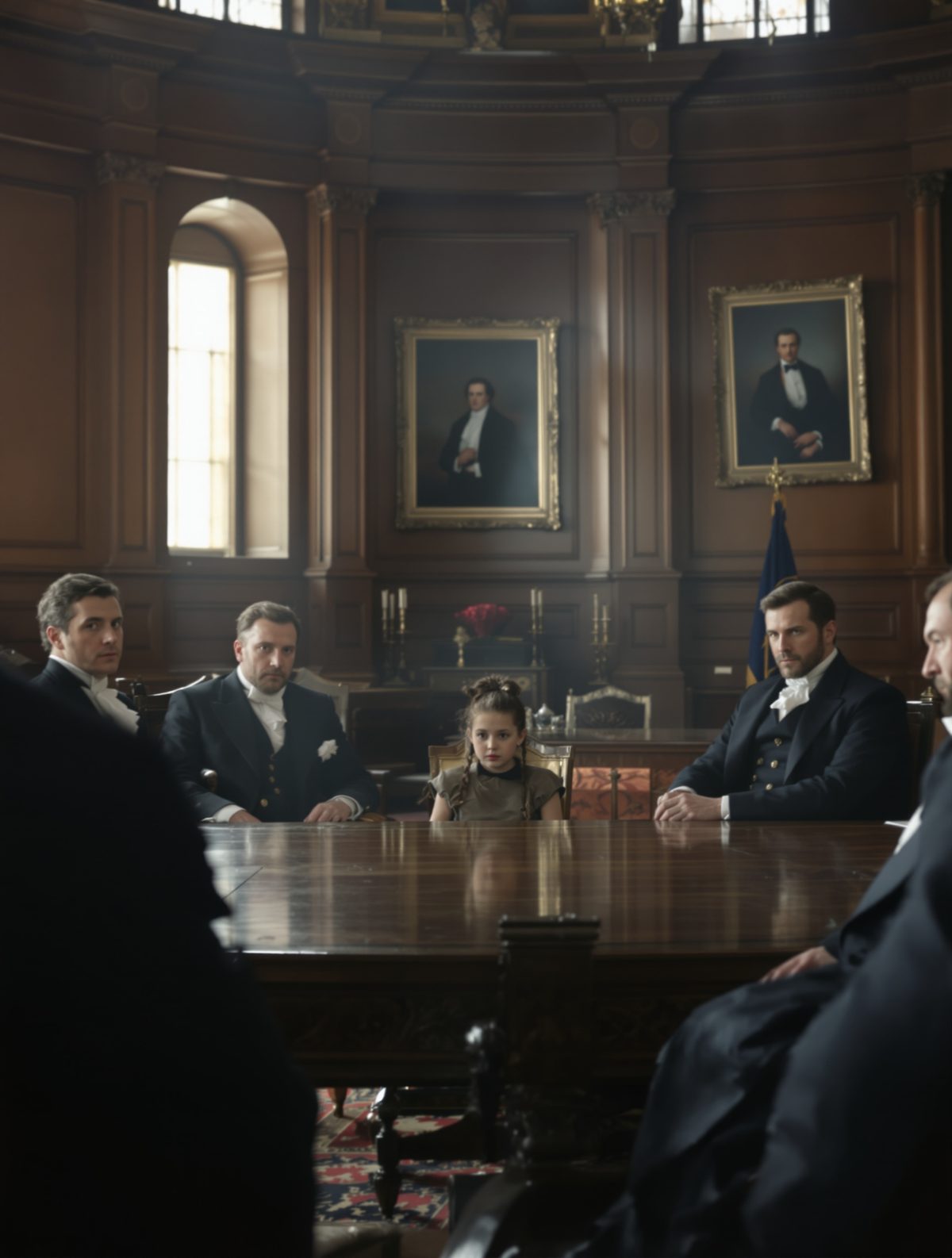
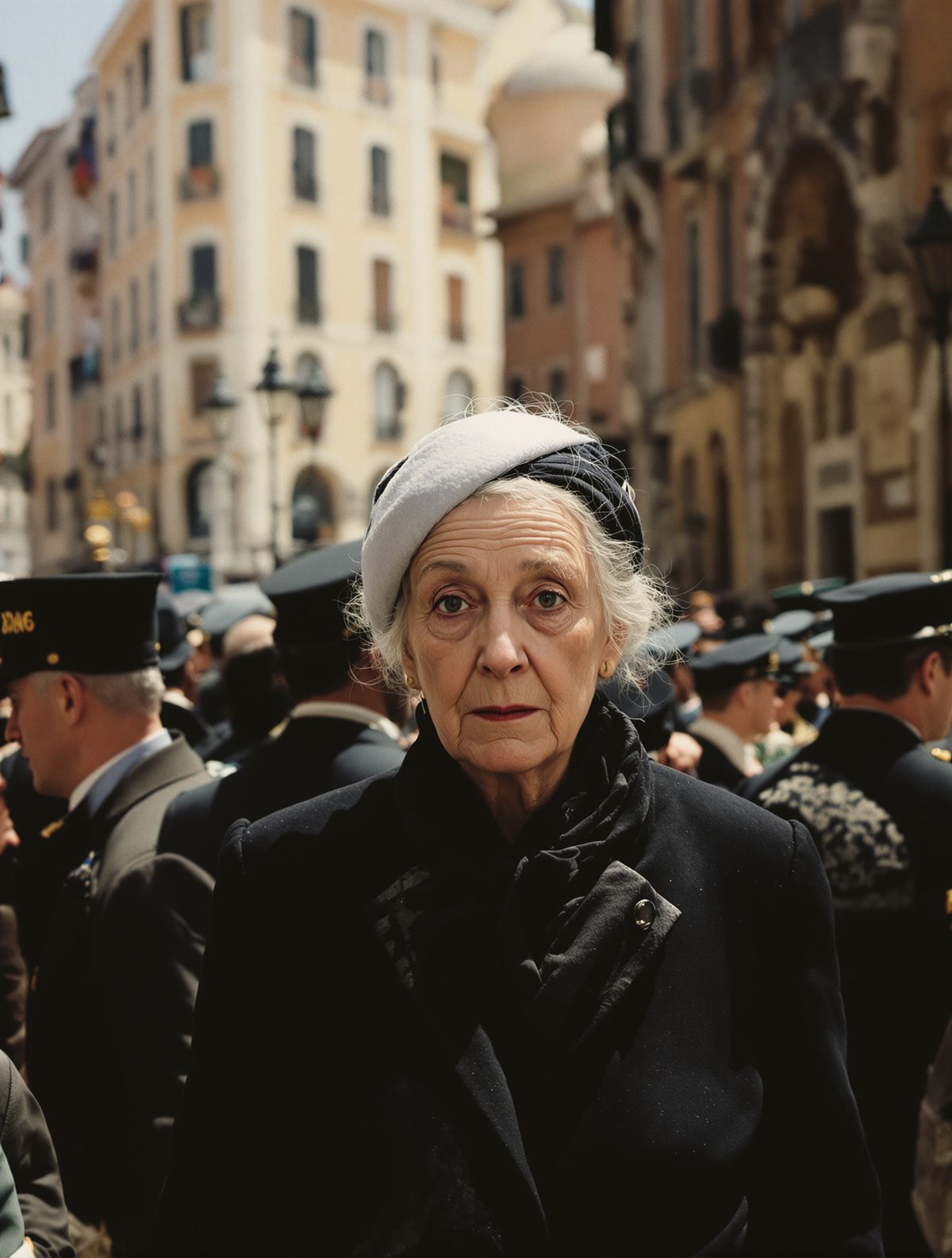
The bullet hung in the air for a fraction of a second—close enough to singe the flesh, fast enough to alter the course of human history. On the morning of April 7, 1926, in the golden light of a Roman spring, fate balanced on the edge of a pistol barrel. The finger that pulled the trigger belonged not to a trained assassin or political operative, but to a 50-year-old Irish mystic named Violet Gibson, whose single shot came within millimeters of preventing World War II.
As Benito Mussolini stepped into the sunlight outside Rome's Capitol building, his nose bandaged and his legend somehow enhanced, few could imagine that this near-miss would be forgotten by history. But in that split second when metal met flesh, when a Dublin debutante's desperate gamble almost succeeded, the world pivoted on the thinnest of margins.
The Unlikely Assassin
Violet Gibson was nobody's idea of a revolutionary. Born into the heart of the Anglo-Irish establishment in 1876, she was the daughter of Edward Gibson, 1st Baron Ashbourne, who served as Lord Chancellor of Ireland under Conservative governments. The Gibson family moved in the highest circles of Dublin society—their Georgian mansion on Merrion Square hosted cabinet ministers, judges, and aristocrats.
Yet beneath the surface of privilege, Violet Gibson harbored a restless spirit that would prove impossible to contain. In her twenties, she shocked her Protestant family by converting to Catholicism, a decision that created lasting rifts but also revealed her capacity for dramatic, life-altering choices. She never married, instead dedicating herself to increasingly mystical religious pursuits that gradually isolated her from polite society.
By the 1920s, Gibson had become something of a wandering ascetic, drifting across Europe with little more than her faith and a modest allowance from her family's trust. She claimed to receive visions, spoke of divine missions, and exhibited behavior that concerned those who knew her. What her family dismissed as religious mania, however, was perhaps something more prophetic—a growing obsession with the rise of fascism and what she saw as its threat to Christian civilization.
In Rome, where she had settled to be closer to the Vatican, Gibson watched with mounting horror as Mussolini consolidated power. Il Duce's theatrical rallies, his violent Blackshirts, and his increasingly dictatorial grip on Italy struck her as fundamentally evil. In her tortured mind, a divine calling began to crystallize: she would stop him herself.
The Morning Everything Changed
April 7, 1926, dawned bright and warm in Rome. Mussolini, then 42 years old and at the height of his domestic popularity, was scheduled to address the International Congress of Surgeons at the Capitol. It was meant to be a routine appearance—a chance for Il Duce to bask in the admiration of international medical professionals and reinforce his image as a modern, scientifically-minded leader.
Violet Gibson had been planning this moment for weeks, perhaps months. She had purchased a small revolver and spent time observing Mussolini's public appearances, noting the patterns of his security detail and the predictable routes he took. On this particular morning, she positioned herself among the crowd of well-wishers and curious onlookers who had gathered to catch a glimpse of the dictator.
At approximately 10:30 AM, Mussolini emerged from the building, flanked by officials and security men. He was in his element—chest thrust out, jaw set in that familiar pugnacious expression, soaking up the cheers of the crowd. The sun caught the elaborate decorations on his uniform as he paused to acknowledge the applause.
This was the moment Gibson had been waiting for. With a steadiness that belied her reputation for instability, she raised her pistol and fired a single shot from point-blank range. The bullet, traveling at over 800 feet per second, missed Mussolini's temple by mere millimeters, instead tearing through the cartilage of his nose before embedding itself harmlessly in the stone behind him.
Chaos in the Piazza
The immediate aftermath was pandemonium. Mussolini, blood streaming down his face, staggered backward as his security detail threw themselves forward. The crowd erupted in screams and confusion, with some people diving for cover while others surged forward to get a better look. In later accounts, witnesses would marvel at the almost supernatural calm that Gibson displayed—she made no attempt to flee, fire a second shot, or even lower the weapon.
The dictator's reaction would become the stuff of legend. Rather than retreat to safety, Mussolini stanched the bleeding with a handkerchief and insisted on continuing with his scheduled speech. "If I advance, follow me," he declared to the crowd, borrowing a phrase from the arditi (Italy's elite assault troops from World War I). "If I retreat, kill me. If I die, avenge me." The crowd, electrified by this display of machismo, roared its approval.
Gibson, meanwhile, was being roughly handled by the security officers and an increasingly angry mob. Several people in the crowd began striking her, and she might well have been lynched on the spot if not for the intervention of the police. As she was dragged away, witnesses reported that she seemed almost serene, as if she had accomplished exactly what she set out to do—even though her target was very much alive.
The bullet had missed its mark by the slimmest of margins, but in the twisted logic of dictatorship, even a failed assassination attempt could be turned to advantage. Mussolini's calm under fire, his refusal to be cowed by violence, and his dramatic decision to carry on with his speech all enhanced his reputation for invincibility.
The Woman History Forgot
What happened to Violet Gibson next reveals much about the casual sexism and class prejudices of the era. Despite having just attempted to kill one of Europe's most powerful leaders, she was quickly dismissed as a harmless madwoman whose actions were the product of mental illness rather than political conviction. The Italian authorities, perhaps influenced by diplomatic pressure from Britain, seemed almost embarrassed by the incident.
Rather than face a dramatic trial that might have given Gibson a platform to explain her actions, she was quietly declared insane and deported to Britain within months of the assassination attempt. Her family, mortified by the international attention, arranged for her to be confined to St. Andrew's Hospital, a private psychiatric institution in Northampton, where she would spend the remaining 30 years of her life.
The British press, when it covered the story at all, portrayed Gibson as a delusional spinster whose actions were motivated by religious mania rather than political insight. The Times described her as "a woman of unstable mind," while other papers focused on her conversion to Catholicism and her history of eccentric behavior. Few bothered to examine whether her assessment of Mussolini as a dangerous threat to European peace might have been remarkably prescient.
Even more remarkably, Gibson herself seemed to fade from public memory with extraordinary speed. Unlike other would-be assassins who achieved a kind of infamy, her name disappeared from the headlines within weeks. By the time Mussolini marched on Ethiopia in 1935, or aligned himself with Hitler in 1936, virtually no one remembered the Irishwoman who had tried to stop him when it might still have mattered.
The Bullet That Could Have Changed Everything
To understand the true significance of Gibson's near-miss, one must consider the Italy of 1926. Mussolini's regime, while authoritarian, had not yet descended into the full horrors that would characterize fascism in the 1930s and 1940s. The alliance with Nazi Germany was still years away, as was Italy's disastrous entry into World War II. The invasion of Ethiopia, which would alienate Italy from the Western democracies and push Mussolini toward Hitler, was nearly a decade in the future.
Had Gibson's bullet found its target, the ripple effects across European history would have been profound. Without Mussolini's intervention in the Spanish Civil War, Franco might never have consolidated power in Spain. Without the Rome-Berlin Axis, Hitler would have faced a very different strategic situation in the Mediterranean and North Africa. The invasion of Greece, which delayed Operation Barbarossa and may have cost Germany the chance to capture Moscow before winter, might never have happened.
Even more intriguingly, Mussolini's survival and his cultivation of an image of invincibility may have emboldened other dictators. Hitler certainly studied Mussolini's methods, and the Italian leader's apparent ability to survive even assassination attempts contributed to the aura of destined leadership that both men cultivated.
The specific trajectory of the bullet—grazing the nose rather than penetrating the skull—also had immediate consequences. A dead Mussolini would have been a martyr, but a wounded Mussolini who carried on with his speech became a legend. The image of Il Duce, blood on his face but still defiant, became one of the defining photographs of the fascist era.
When History Turns on a Hair's Breadth
Violet Gibson died in obscurity in 1956, her story largely forgotten by a world that had moved on to new crises and conflicts. Yet her failed assassination attempt raises profound questions about the role of individual action in shaping historical events. Here was a woman with no political training, no organizational support, and no realistic plan beyond firing a single shot—and she came closer to preventing World War II than entire governments would manage in the years that followed.
The incident also illuminates the gendered nature of historical memory. Male assassins and would-be assassins—from John Wilkes Booth to Gavrilo Princip—become household names, their motivations endlessly analyzed and debated. Female attempts at political violence, by contrast, are often dismissed as the products of mental instability or personal grievance. Gibson's religious mysticism made it easy to categorize her as a madwoman rather than a political actor, but this interpretation conveniently ignored the accuracy of her assessment of fascism's threat.
In our current era of strongman politics and democratic backsliding, Gibson's story resonates with uncomfortable relevance. Her recognition of fascism's danger—years before most European leaders took the threat seriously—suggests that sometimes the supposedly mad are simply seeing clearly what others choose to ignore. The millimeters that separated her bullet from its target remind us how often history pivots on the smallest of chances, and how the actions of a single determined individual can ripple across decades.
The next time you read about the rise of Mussolini or the origins of World War II, spare a thought for Violet Gibson—the Irishwoman whose steady hand and clear aim nearly changed everything, and whose failure to do so condemned millions to a war that might never have been.