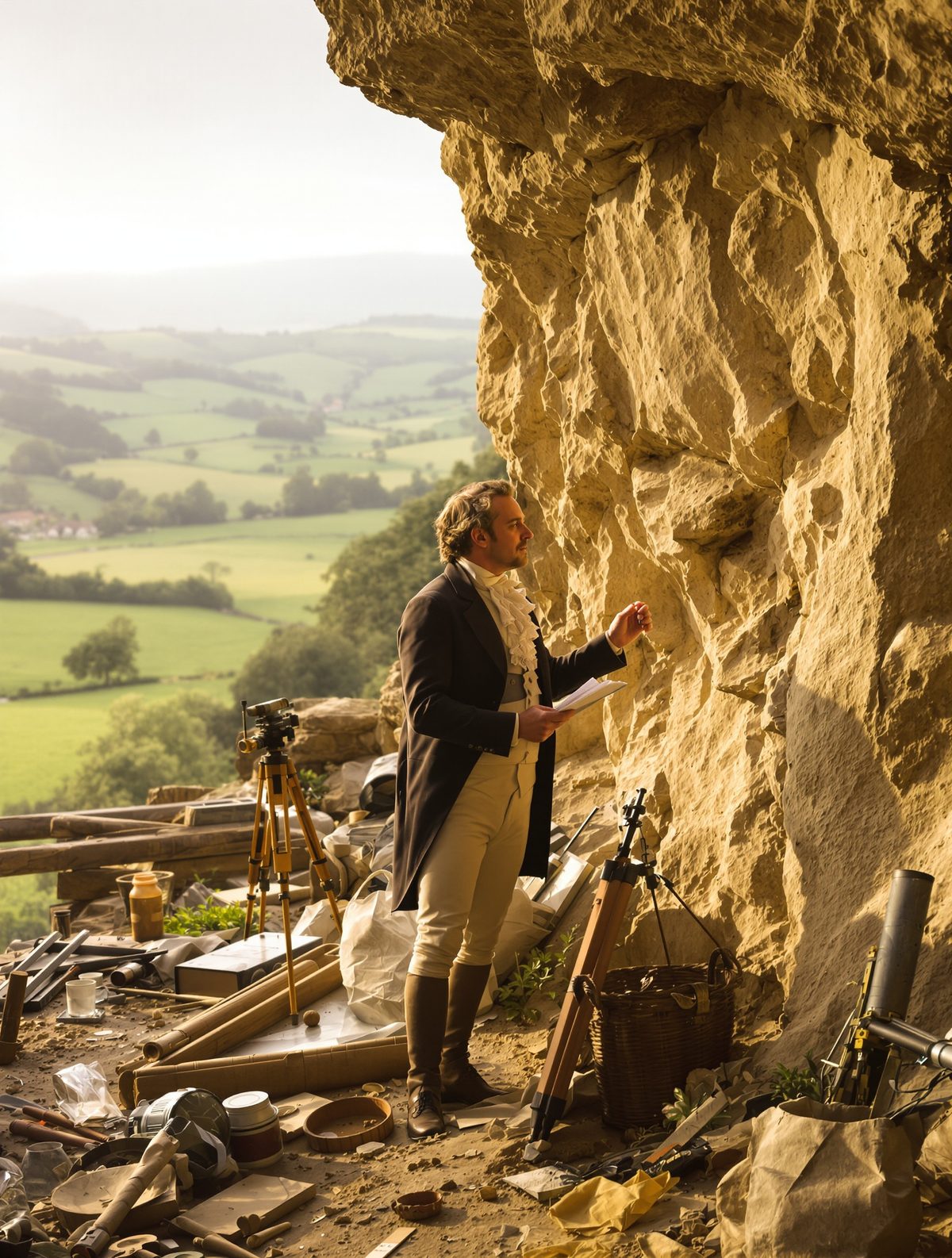
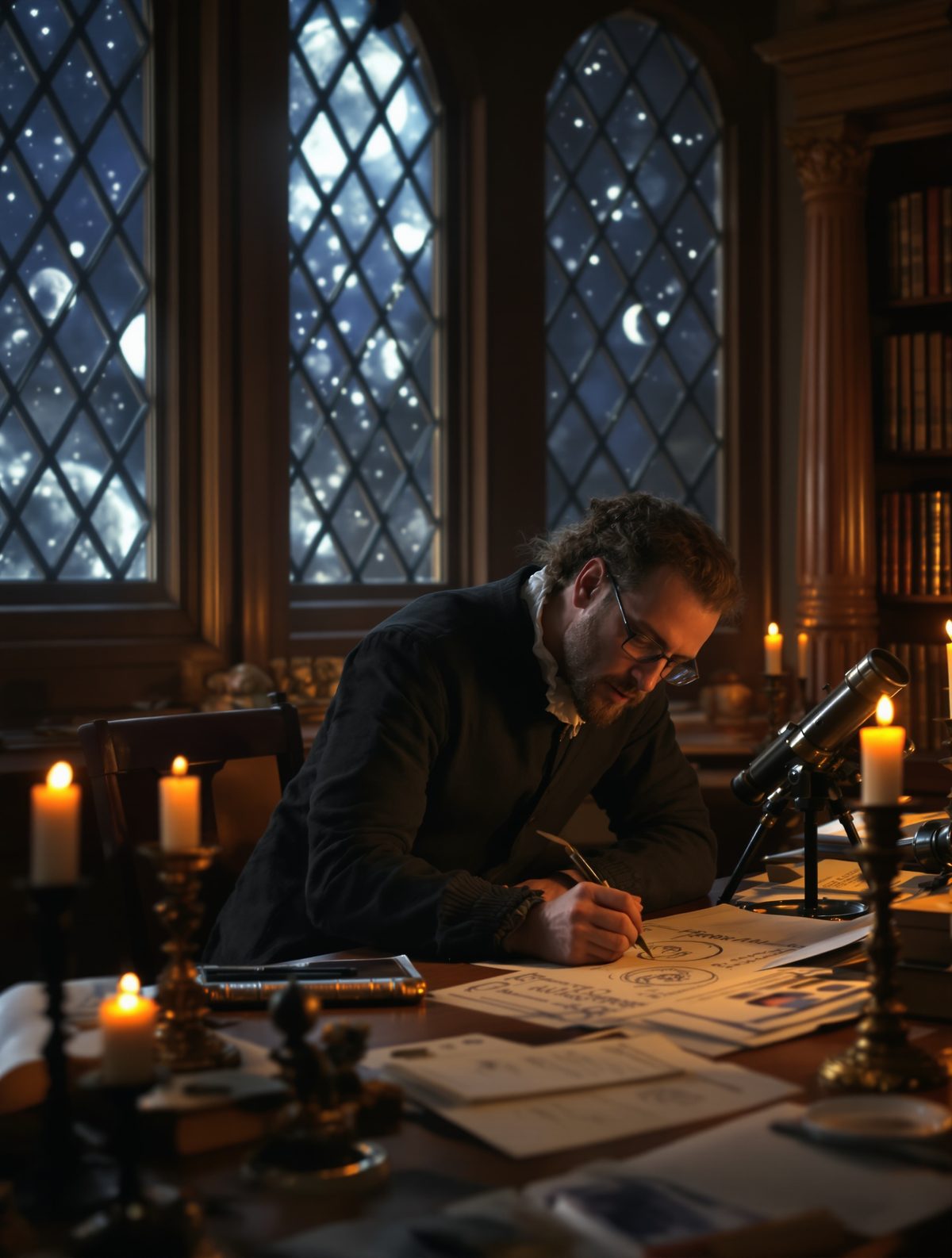
On the evening of July 26, 1609, in a modest garden in Syon House, Middlesex, mathematician Thomas Harriot lifted a peculiar contraption to his eye and pointed it toward the waxing moon. The instrument—a crude telescope of his own making—transformed the familiar silvery orb into an alien landscape of shadows and light. What he saw that night would revolutionize humanity's understanding of the cosmos, yet his name would be all but erased from the history books.
Four months before Galileo's celebrated lunar observations made headlines across Europe, this brilliant but forgotten Englishman became the first human being to map another world. His meticulous drawings revealed a Moon scarred by craters and crowned with mountains—a celestial body as complex and varied as Earth itself. It was a discovery that should have made him immortal. Instead, Thomas Harriot became history's greatest "what if."
The Gentleman Scholar of Syon House
Thomas Harriot was no ordinary stargazer. Born around 1560 in Oxford, he had already lived several lifetimes' worth of adventure by the time he first peered through that telescope. As a young man, he had sailed with Sir Walter Raleigh to the Virginia colony in 1585, where he learned Algonquian languages, mapped the Outer Banks, and wrote the first English scientific account of the New World. He was part mathematician, part explorer, part linguist—a true Renaissance polymath.
By 1609, Harriot had found patronage with Henry Percy, the 9th Earl of Northumberland, living comfortably at Syon House on the Thames. The Earl, known as the "Wizard Earl" for his fascination with the occult and natural philosophy, provided Harriot with the perfect environment for scientific inquiry. Here, surrounded by one of England's finest libraries and equipped with the leisure to pursue his investigations, Harriot turned his attention to the heavens.
News of Hans Lippershey's "Dutch perspective glass" had reached England by early 1609, and Harriot—ever the inventor—set about creating his own version. His first telescope magnified objects by a factor of six, modest by later standards but revolutionary for its time. Unlike many of his contemporaries who viewed the telescope as little more than a military curiosity, Harriot immediately grasped its astronomical potential.
First Light on Another World
The Moon that Harriot observed on that July evening was in its first quarter phase—the perfect condition for telescopic observation. The terminator, that sharp line dividing the Moon's day and night sides, cast dramatic shadows that revealed the true topography of the lunar surface for the first time in human history.
What Harriot saw contradicted everything astronomers believed about the Moon. Rather than the perfect, smooth sphere described by Aristotelian philosophy, he observed a world of jagged mountains and deep craters. The "rough and uneven" surface, as he described it in his notes, was pocked with circular formations that caught and held shadows like bowls.
His drawing from that first night shows remarkable detail for such primitive equipment. Using pen and ink, he carefully rendered the terminator's irregular edge, noting how it bristled with peaks and valleys. Most significantly, he observed and documented what we now know as the crater Albategnius, making him the first person to identify a specific lunar feature.
But Harriot didn't stop with a single observation. Over the following months, he returned to his telescope again and again, creating increasingly detailed maps as his technique improved and he acquired better instruments. By 1610, he was using a telescope with twenty-fold magnification, producing drawings of stunning accuracy that wouldn't be surpassed for decades.
The Galileo Problem
Four months after Harriot's first lunar observations, Galileo Galilei pointed his own telescope at the Moon from Padua. The Italian's observations, published in his Sidereus Nuncius (Starry Messenger) in March 1610, sent shockwaves through European intellectual circles. Here was proof that the heavens were not the realm of perfection that ancient philosophy claimed—the Moon was a world much like our own, with mountains that Galileo calculated to be several miles high.
Galileo's genius lay not just in his observations but in his publicity. He dedicated his work to Cosimo II de' Medici, coined dramatic names for his discoveries, and wrote in accessible Latin that scholars across Europe could read. His lunar drawings, while less detailed than Harriot's, were published alongside revolutionary observations of Jupiter's moons and countless previously invisible stars.
Meanwhile, Harriot kept his discoveries largely to himself. His drawings remained in private notebooks, shared only with a small circle of correspondents. This wasn't unusual for the time—many natural philosophers were secretive about their work, fearing controversy or wanting to perfect their observations before publication. But it proved fatal to Harriot's historical legacy.
The Man Who Mapped the Impossible
What makes Harriot's achievement even more remarkable is the precision of his work. Modern analysis of his drawings reveals details that match lunar features with startling accuracy. His map of the full Moon, created around 1613, shows the major lunar seas (maria) in their correct relative positions and includes crater chains, ray systems, and mountain ranges that wouldn't be properly catalogued until centuries later.
Harriot also understood what he was seeing in ways that Galileo initially did not. While Galileo focused on proving that the Moon had mountains, Harriot realized he was observing impact craters—circular formations created by cosmic collisions. His notes describe these features with the analytical mind of a mathematician, calculating angles of illumination and estimating the heights of lunar peaks using shadow measurements.
Perhaps most impressively, Harriot was the first to observe the phenomenon we now call "earthshine"—the faint illumination of the Moon's dark side caused by sunlight reflected from Earth. He correctly deduced that this ghostly glow was Earth's own light reflected back, making him the first person to understand that our planet shines in space just as the Moon does from our perspective.
His astronomical work extended far beyond the Moon. Harriot was among the first to observe sunspots through a telescope, documenting their movement across the solar surface and correctly inferring that the Sun rotates. He studied Jupiter's moons, observed the phases of Venus, and created star charts of remarkable accuracy. Yet virtually none of this work was published during his lifetime.
The Protestant Plotter's Dilemma
Harriot's reluctance to publish may have been influenced by more than scientific caution. His patron, the Earl of Northumberland, was imprisoned in the Tower of London in 1605 on suspicion of involvement in the Gunpowder Plot. Though the Earl was likely innocent, the association made anyone in his household politically suspect.
Harriot himself faced accusations of atheism—a serious charge in early Stuart England. His mathematical approach to understanding the natural world, combined with his reluctance to publish findings that contradicted biblical cosmology, suggests a man walking a careful line between scientific truth and social survival.
The irony is palpable: while Galileo faced the Roman Inquisition for his astronomical work and emerged as history's hero of scientific freedom, Harriot avoided controversy by staying silent and disappeared from history entirely. One man's persecution ensured his immortality; another man's caution guaranteed his obscurity.
Legacy of the Lost Pioneer
Thomas Harriot died in 1621, taking his unpublished discoveries with him to the grave. His manuscripts gathered dust in various archives for centuries, their significance unrecognized. It wasn't until the 20th century that historians began to piece together the full scope of his achievements, revealing a scientific mind that rivaled any of his more famous contemporaries.
Today, lunar crater Harriot bears his name—a fitting tribute to the man who first mapped the Moon's alien landscape. But the broader lesson of his story resonates far beyond astronomy. In our age of social media and instant publication, Harriot reminds us that making a discovery is only half the battle—sharing it with the world is what transforms private insight into human knowledge.
The next time you look up at the Moon, remember that summer night in 1609 when an English mathematician first saw it as a world rather than a light. In that moment of revelation, Thomas Harriot didn't just map the Moon—he expanded the very definition of what it meant to explore. His forgotten achievement raises a tantalizing question: how many other pioneers have we lost to history's selective memory?