
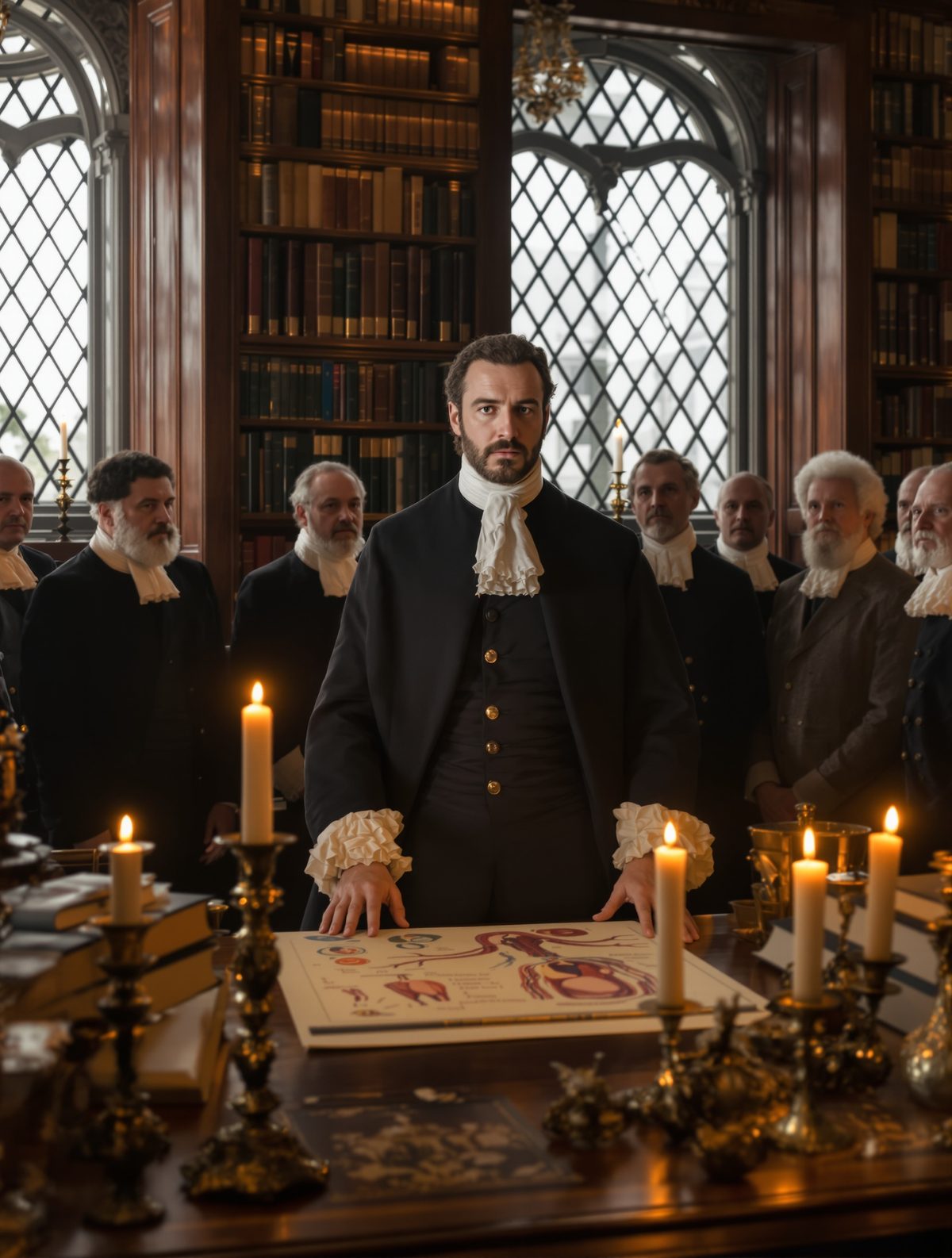
The silence in the Royal College of Physicians was deafening. It was April 1628, and fifty-year-old William Harvey stood before England's most prestigious doctors, clutching a revolutionary manuscript that would destroy everything they believed about the human body. For fourteen centuries, physicians had taught that the heart was little more than a divine furnace, warming blood that the body consumed like coal in a fire. Harvey was about to prove them catastrophically wrong.
As he cleared his throat and began to speak, Harvey knew he was committing professional suicide. The assembled physicians—men who had spent decades memorizing the sacred texts of ancient medicine—were about to learn that their entire understanding of life itself was based on a colossal misunderstanding.
The Ancient Lie That Ruled Medicine
To understand Harvey's courage, you must first grasp the iron grip that ancient dogma held over 17th-century medicine. Since 200 AD, every doctor in Europe had sworn by the teachings of Claudius Galenus—known simply as Galen—a Greek physician who had dissected apes and declared his findings universal law for human anatomy.
According to Galen's model, the liver constantly manufactured fresh blood from food, like a medieval brewery churning out ale. This blood then flowed to the heart, where it was gently warmed and infused with "vital spirits" before being distributed throughout the body via the arteries. The veins carried a completely separate system of "nutritive blood" that the tissues gradually consumed, requiring constant replenishment.
It was elegant, logical, and completely wrong.
For nearly one and a half millennia, no one had dared question this system. Medical students at Cambridge, Oxford, and Padua memorized Galen's texts word for word. Challenging these teachings wasn't just academically dangerous—it bordered on heresy, since the Church had woven Galen's theories into Christian doctrine about the divine nature of the human body.
The Quiet Revolutionary from Folkestone
William Harvey seemed an unlikely candidate to overturn centuries of medical orthodoxy. Born in 1578 in the sleepy Kent town of Folkestone, he was the eldest son of a prosperous yeoman farmer who dealt in wool and timber. Nothing about his early life suggested he would become medicine's greatest revolutionary.
But Harvey possessed two qualities that would prove explosive when combined: an insatiable curiosity and an absolute refusal to accept authority without evidence. After studying at Cambridge, he traveled to the University of Padua—Europe's premier medical school—where he encountered something that would change his life forever.
His professor, Hieronymus Fabricius, had recently made a puzzling discovery. Inside veins, he had found small flaps of tissue that seemed to serve no purpose according to Galen's theories. Fabricius called them "little doors"—valvulae in Latin—but couldn't explain what they were for. To him, they were merely curious anatomical footnotes.
To Harvey, they were the key to everything.
The Breakthrough in a Candlelit Study
Returning to London in 1602, Harvey established a successful practice while quietly conducting experiments that would have horrified his patients. In his study, by flickering candlelight, he dissected everything he could lay his hands on: deer hearts from royal hunts, sheep organs from butcher shops, and occasionally, when he could obtain them, human cadavers from executed criminals.
What Harvey observed defied everything he had been taught. When he tied a ligature around a dog's vein, blood pooled on the side closest to the heart—not away from it, as Galen's theory predicted. When he pressed on veins in his own arm, he could see blood being forced toward his heart, not away from it. Those mysterious "little doors" that Fabricius had found? They were one-way valves, ensuring blood could only flow in a single direction.
But Harvey's most startling discovery came from simple mathematics—a tool physicians rarely used. He calculated that the human heart, beating roughly 72 times per minute, would pump about 2,000 gallons of blood per hour according to Galen's model. This meant the liver would need to manufacture three times a person's body weight in blood every single hour.
It was impossible. There had to be another explanation.
The Moment That Changed Everything
The revelation struck Harvey like lightning around 1615. Blood didn't flow in straight lines from liver to heart to body and disappear. It moved in a circle. The same blood that the heart pumped out through the arteries returned through the veins, creating an endless loop. The heart wasn't a heater—it was a pump.
For thirteen years, Harvey quietly gathered evidence, knowing that his theory would trigger a medical earthquake. He conducted over 60 different experiments, many on live animals that allowed him to observe the beating heart in action. He watched blood spurt from severed arteries in rhythm with the heartbeat. He observed how blood drained from arteries when he cut veins, proving the two systems were connected.
He even experimented on himself, using tight bands around his arm to demonstrate how blood flowed through veins toward the heart—an experiment you can replicate today by pressing firmly on the veins in your forearm and watching them empty.
The Day Medicine Changed Forever
When Harvey finally presented his findings to the Royal College of Physicians in 1628, the reaction was explosive. His 72-page manuscript, "Exercitatio Anatomica de Motu Cordis et Sanguinis in Animalibus" (An Anatomical Study of the Motion of the Heart and Blood in Animals), didn't just challenge medical orthodoxy—it obliterated it.
The medical establishment reacted with fury. Dr. James Primrose called Harvey's theory "paradoxical, useless, false, impossible, absurd, and harmful." Continental physicians dubbed him "Circulator"—a play on his circulation theory that also meant "quack" in medical Latin. Some colleagues stopped referring patients to him, convinced he had lost his mind.
But Harvey had two powerful allies: evidence and King Charles I himself. The king, fascinated by Harvey's demonstrations, allowed him to conduct experiments on deer in the royal parks. Charles even participated in dissections, and Harvey's position as royal physician protected him from the worst professional persecution.
Gradually, as younger physicians replicated Harvey's experiments, the evidence became overwhelming. The great English philosopher Thomas Hobbes captured the magnitude of Harvey's achievement: "He was the only man I know that conquered envy in his lifetime and saw his doctrine established."
The Revolution That Never Ended
Harvey's discovery did far more than correct an ancient error—it fundamentally changed how humans understood life itself. By proving that the body was a mechanical system governed by observable laws rather than mystical forces, he helped birth the scientific revolution that would transform the world.
Today, every cardiac surgery, every blood transfusion, every understanding we have of cardiovascular disease stems from that moment in 1628 when a quiet doctor from Folkestone dared to question what everyone "knew" to be true. Harvey lived to see his theory accepted, dying peacefully in 1657 at age 79—a rare privilege for revolutionaries in any era.
Perhaps most remarkably, Harvey achieved his breakthrough not with sophisticated technology, but with careful observation, logical thinking, and the courage to challenge authority. In our age of complex medical imaging and genetic sequencing, there's something profoundly inspiring about a man who changed medicine forever armed with nothing more than a sharp knife, mathematical calculation, and an unshakeable belief that evidence trumps tradition.
The next time you feel your pulse, remember William Harvey—the man who proved that sometimes the most revolutionary discoveries are hidden in plain sight, waiting for someone brave enough to look with fresh eyes at what everyone else takes for granted.