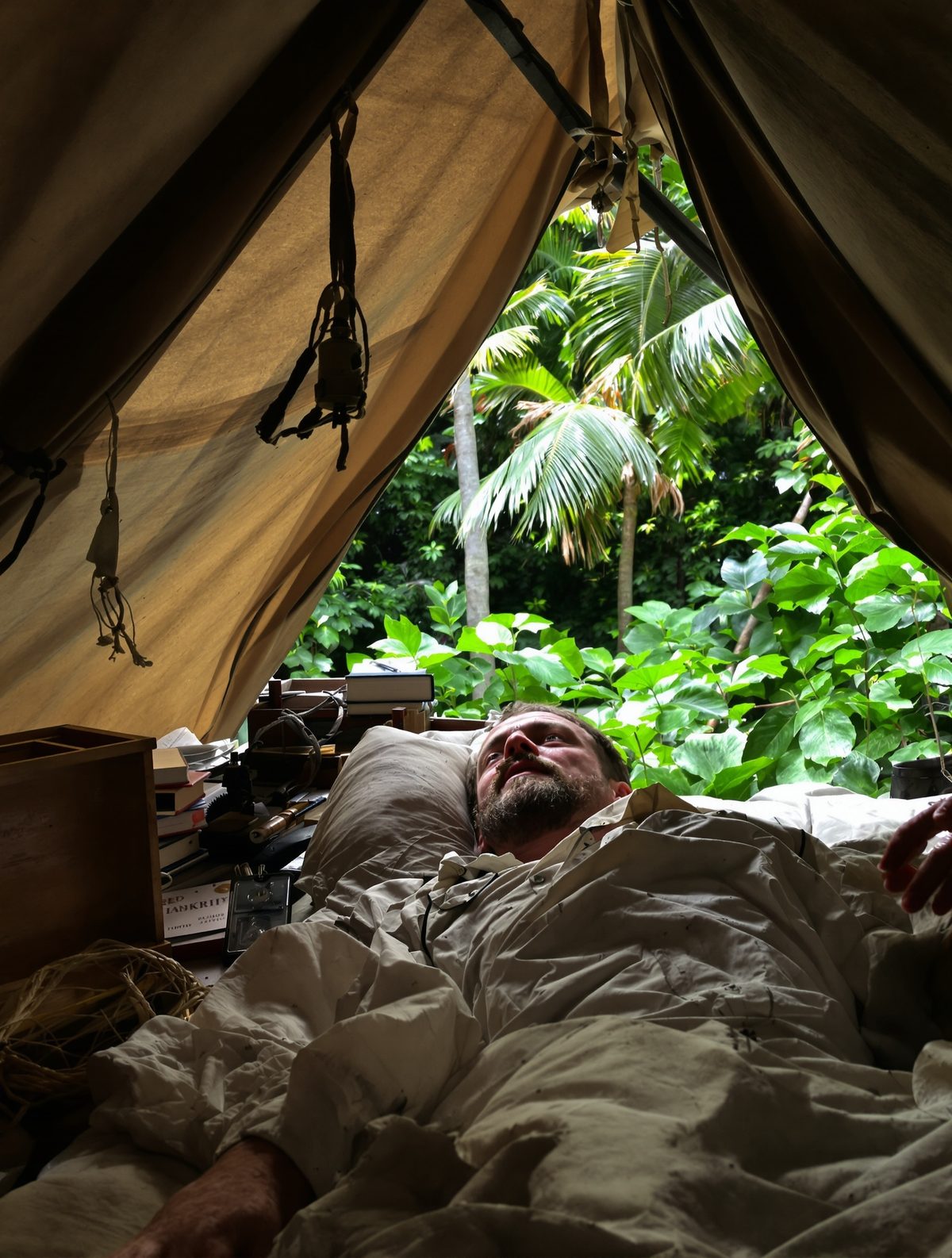
The sweat poured from Alfred Russel Wallace's burning forehead as he writhed on his bamboo bed in the remote village of Dodinga, on the Indonesian island of Halmahera. It was February 1858, and the 35-year-old naturalist was convinced he was dying. The malaria had seized him with violent chills and fever that came in waves, each one threatening to drag him into delirium. But as his temperature soared and his mind began to wander, something extraordinary happened. In that fevered haze, somewhere between consciousness and madness, Wallace's brain made a connection that would shake the very foundations of Victorian science.
What came to him in those crucial hours would later be called "the most famous fever dream in the history of science." For in his delirium, Wallace grasped the complete theory of evolution by natural selection—the same revolutionary concept that Charles Darwin had been secretly developing for twenty years but had never dared to publish.
The Fever That Changed Everything
Wallace had been collecting specimens in the Malay Archipelago for four years, enduring countless hardships in his quest to understand the natural world. The Spice Islands, as they were known, were a paradise for a naturalist—but also a death trap. Malaria, dysentery, and a dozen other tropical diseases claimed European visitors with ruthless efficiency. Wallace had already survived several bouts of fever, but this one was different. This one nearly killed him.
As he lay there on February 7th, 1858, his mind began to wander to an essay he had read years earlier by Thomas Malthus on population growth. Malthus had argued that human populations would always outgrow their food supply, leading to a struggle for survival. Suddenly, through the fog of fever, Wallace saw how this principle might apply to all of nature.
"It occurred to me to ask the question, why do some die and some live?" Wallace would later write. "And the answer was, that on the whole the best fitted live." In that moment of clarity, piercing through his delirium like lightning through storm clouds, Wallace understood that nature was constantly selecting the fittest individuals to survive and reproduce, while the less adapted perished. Generation by generation, this process would gradually transform species.
Racing Against Time and Death
Despite his fever, Wallace recognized the earth-shattering importance of what had just occurred to him. With hands trembling from illness, he began to write. Over the next three days, as his temperature fluctuated wildly, he poured his revolutionary insights onto paper. The result was a 4,000-word essay titled "On the Tendency of Varieties to Depart Indefinitely from the Original Type."
But here's where the story takes a remarkable turn. Wallace, isolated in the Indonesian jungle with what he believed to be the greatest scientific discovery of his lifetime, decided to send his essay to the one person in England he thought might appreciate it: Charles Darwin. He had no idea that Darwin had been sitting on virtually identical conclusions for two decades, too cautious to publish them for fear of the religious and social upheaval they would cause.
Wallace sealed his manuscript in an envelope and sent it on the long journey to England, along with a note asking Darwin to pass it along to the geologist Charles Lyell if he thought it worthy. It was an act of scientific generosity that would prove both fortunate and costly.
Darwin's Terrible Dilemma
The package arrived at Darwin's home in Kent on June 18th, 1858, like a thunderbolt from the blue. Darwin's hands reportedly shook as he read Wallace's essay, recognizing immediately that the young naturalist had independently arrived at the same conclusions that formed the backbone of his own unpublished magnum opus. "I never saw a more striking coincidence," Darwin wrote to Lyell in panic. "If Wallace had my manuscript sketch written out in 1842, he could not have made a better short abstract!"
Darwin found himself facing an agonizing ethical dilemma. Should he rush to publish his own work, which had priority by decades, or step aside and let Wallace claim the discovery? The Victorian gentleman's code of honor demanded the latter, but twenty years of painstaking research hung in the balance. Darwin confided to his friend Joseph Hooker: "I would far rather burn my whole book than that he or any other man should think that I had behaved in a paltry spirit."
What happened next reveals both the best and worst of Victorian scientific culture. Darwin's well-connected friends Lyell and Hooker orchestrated a compromise that would save Darwin's reputation while giving Wallace some credit. On July 1st, 1858, both Wallace's essay and excerpts from Darwin's earlier unpublished writings were read together at a meeting of the Linnean Society in London.
The Gentleman's Agreement That Shaped History
The irony is almost unbearable: neither Darwin nor Wallace was present at this historic moment. Darwin was at home, grieving the death of his infant son from scarlet fever. Wallace was still thousands of miles away in Indonesia, completely unaware that his fever-dream discovery was being presented to the scientific establishment alongside the work of England's most respected naturalist.
The joint presentation barely caused a ripple. The president of the Linnean Society would later remark that 1858 had been a year unmarked by any revolutionary discoveries. But the publication spurred Darwin into action. Within a year, he had rushed into print with "On the Origin of Species," a book that would become one of the most influential works in the history of science.
Wallace, returning to England in 1862, could have been bitter about being overshadowed. Instead, he became one of Darwin's most ardent supporters, even adopting Darwin's term "natural selection" over his own phrase "survival of the fittest." The two men maintained a cordial relationship for the rest of their lives, though Darwin's social connections and head start ensured that evolution would forever be associated primarily with his name.
The Price of a Fever Dream
The bitter truth is that Wallace paid dearly for his moment of brilliance in the Indonesian jungle. While Darwin became wealthy and famous, Wallace struggled financially for much of his life. Despite discovering evolution independently and contributing groundbreaking work on biogeography (the Wallace Line, which separates Asian and Australian fauna, still bears his name), he remained forever in Darwin's shadow.
Wallace's supporters argue that history has been unfair to the man who made one of science's greatest discoveries while burning with fever in a bamboo hut. They point out that Wallace's version of natural selection was actually more comprehensive than Darwin's initial formulation, and that his insights into what we now call ecology were decades ahead of their time.
But perhaps most remarkably, Wallace never expressed resentment about his treatment. "The idea came to me, as it had come to Darwin, and like his, it had come to stay," he wrote years later. For Wallace, the truth itself mattered more than who received credit for discovering it.
Lightning Strikes Twice
Today, as we grapple with questions about scientific collaboration, intellectual property, and fair credit in our interconnected world, Wallace's story offers profound lessons. His fever dream reminds us that revolutionary insights can emerge from the most unlikely circumstances—that sometimes our greatest discoveries come not from methodical research in comfortable laboratories, but from moments of crisis that force our minds to make unexpected connections.
The simultaneous discovery of evolution by Wallace and Darwin also illustrates a fascinating principle in the history of science: when the time is right for an idea, it often emerges independently in multiple minds. The intellectual groundwork laid by previous generations creates fertile soil where revolutionary concepts can suddenly bloom, like flowers opening after rain.
Perhaps most importantly, Wallace's generous spirit in the face of being overshadowed reminds us that the pursuit of truth is ultimately more important than personal glory. In our age of fierce competition for scientific priority and social media fame, Alfred Russel Wallace's fever dream stands as a testament to the power of curiosity, courage, and intellectual humility. The legends may have left him out of the textbooks, but his moment of feverish brilliance in an Indonesian jungle helped change our understanding of life itself.