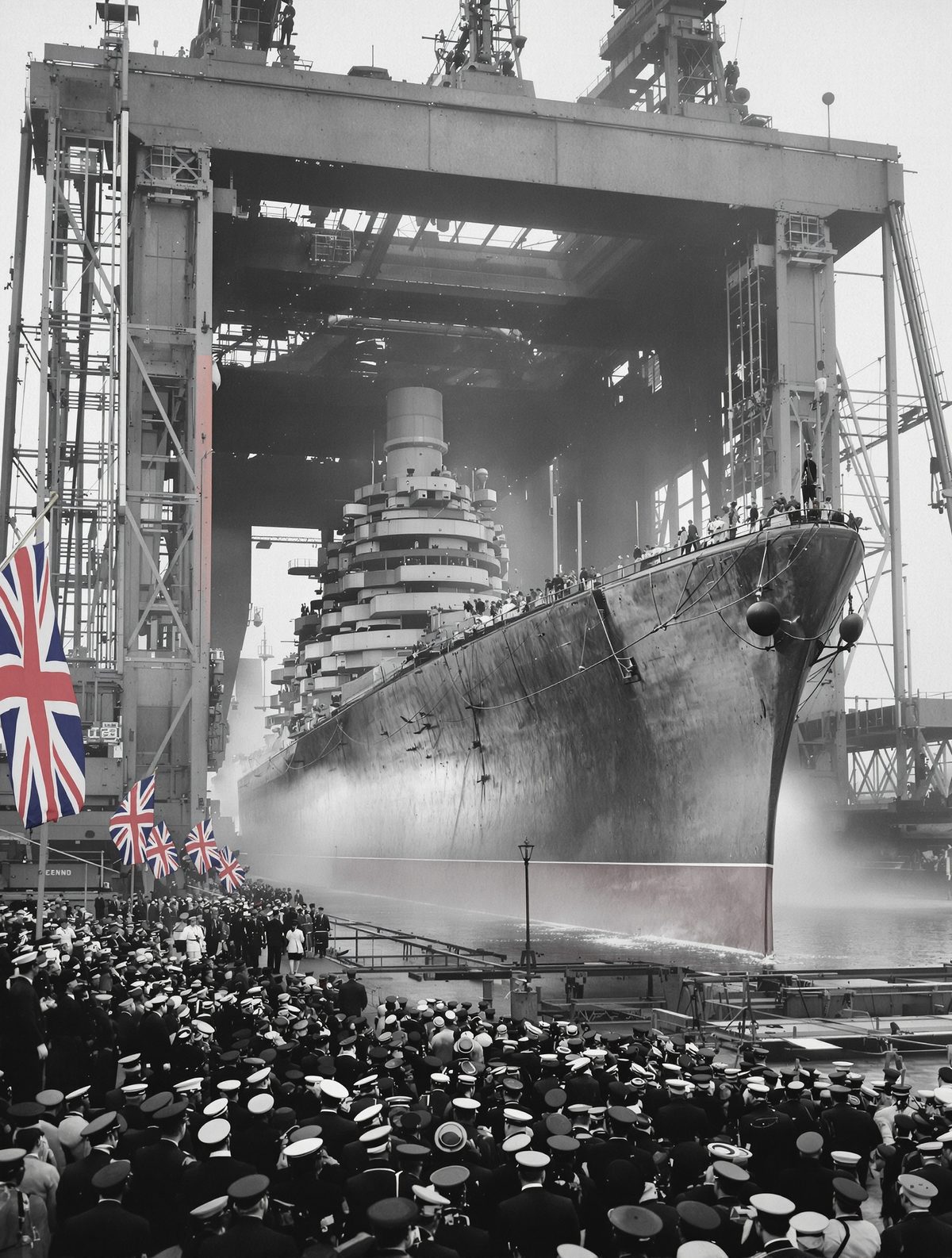
On February 10th, 1906, a crowd of 40,000 spectators gathered at Portsmouth Dockyard to witness what appeared to be an ordinary ship launch. King Edward VII himself had come to christen the vessel, and the assembled naval dignitaries seemed pleased with their new addition to the fleet. What none of them fully grasped was that they were watching the most significant revolution in naval warfare since the invention of gunpowder. In 366 days—a building time so impossibly fast it seemed like magic—Britain had constructed a single warship that would instantly render obsolete every battleship on Earth, including most of their own.
The grey-hulled leviathan sliding into Portsmouth harbour that winter morning was HMS Dreadnought, and she was about to rewrite the rules of naval power forever.
The Maverick Admiral's Impossible Dream
Admiral Sir John "Jackie" Fisher was exactly the kind of man the Royal Navy's stuffy establishment loved to hate. Short, stocky, and utterly convinced of his own genius, Fisher had a habit of dancing at formal dinners and once declared that his favourite tune was "Onward Christian Soldiers" because it reminded him of "torpedoing the enemy." When he became First Sea Lord in 1904, Fisher looked out at Britain's mighty fleet of battleships and saw not strength, but dangerous complacency.
The problem was startlingly simple: every battleship in the world was essentially the same. They carried a mixture of big guns and small guns, fired at relatively close range, and hoped for the best. Fisher, who had witnessed the decisive Japanese victory at the Battle of Tsushima in 1905, realized that future naval battles would be fought at much greater distances. In such encounters, the small and medium-calibre guns that cluttered most battleships would be utterly useless—only the biggest guns would matter.
So Fisher proposed something radical: a battleship armed with nothing but big guns. Ten 12-inch cannons, each capable of hurling an 850-pound shell over thirteen miles. No clutter, no compromise, just overwhelming firepower combined with revolutionary speed. The Admiralty's reaction was predictably scandalized. One senior officer spluttered that Fisher's design looked like "a lot of gun barrels sticking out of a pot."
Fisher didn't care. He had mathematics on his side. His revolutionary design could fire twice the weight of shell of any existing battleship, and do it from a distance where enemy vessels couldn't effectively fight back.
The Secret That Shocked the World
What made Dreadnought truly revolutionary wasn't just her guns—it was what powered them. While every other battleship in the world still relied on coal-fired reciprocating engines, Fisher had equipped his creation with steam turbines, the same technology used in the fastest ocean liners. The result was breathtaking: Dreadnought could steam at 21 knots, fast enough to choose when and where to fight.
The engineering challenges were immense. The ship's ten massive guns created problems no naval architect had ever faced. When all five turrets fired simultaneously, the blast could shatter the windows in the ship's superstructure and literally lift sailors off their feet. The solution was typically Fisher: if the ship was too violent for conventional construction, then they'd build an unconventional ship.
Dreadnought's hull incorporated lessons learned from submarine design—another Fisher obsession that had horrified traditionalists. Her compartmentalization was more extensive than any previous warship, and her design prioritized survivability as much as firepower. She was, in essence, the world's first modern battleship, built according to principles that wouldn't be fully understood until decades later.
Building the Impossible in Record Time
Perhaps the most astonishing aspect of the Dreadnought story was the speed of her construction. Fisher, obsessed with secrecy and driven by the fear that other nations might steal his ideas, demanded that the ship be built in less than a year. The traditional construction time for a battleship was three to four years.
What followed was a masterpiece of industrial organization that would have impressed Henry Ford. Fisher had components pre-fabricated before the keel was even laid. He stripped guns and armor from other ships under construction, reassigning entire production lines to his pet project. Workers labored in shifts around the clock, and the Portsmouth Dockyard hummed with activity that never ceased.
The keel was laid on October 2nd, 1905. Just four months and eight days later, the completed hull was ready for launch. By October 1906—exactly one year and one day after construction began—Dreadnought was ready for sea trials. The German Kaiser, who fancied himself a naval expert, reportedly refused to believe the reports, insisting that no ship could be built so quickly.
Fisher's secret was that he wasn't just building a ship—he was proving that British industrial capacity could outpace any rival. The message was clear: if Britain could build one revolutionary battleship in a year, imagine what they could accomplish given time.
The Day Every Navy Became Obsolete
The moment Dreadnought entered service, she created a new category of warship. Naval historians began referring to "pre-dreadnought" and "dreadnought" battleships, as if Fisher's creation had literally divided naval history into before and after. The impact was immediate and global.
Germany's Kaiser Wilhelm II, who had been steadily building up his navy to challenge British supremacy, watched his entire fleet become obsolete overnight. The Germans had been constructing battleships of the Deutschland class, formidable vessels that could have challenged any ship in the Royal Navy. Against Dreadnought, they were floating anachronisms.
The Americans, French, Russians, and Japanese all faced the same horrible realization: their massive investments in conventional battleships had been rendered worthless by one British ship. It was as if Britain had suddenly developed fighter jets while everyone else was still building biplanes.
But Fisher's masterstroke contained a delicious irony that he may not have fully anticipated. By making every battleship obsolete, including Britain's own, he had effectively reset the naval arms race to zero. Every nation would now have to build dreadnoughts or accept naval irrelevance. Britain's centuries-old fleet advantage had been voluntarily sacrificed for one crucial benefit: they had a one-year head start in the new competition.
The Monster That Started a Revolution
Dreadnought herself was a fearsome sight on the high seas. At 526 feet long and displacing 18,000 tons, she was larger than any previous British battleship. Her five twin-gun turrets gave her a profile unlike anything afloat—low, purposeful, and bristling with weaponry. When she fired a full broadside, the noise could be heard for miles, and the concussion was powerful enough to knock small boats out of the water.
During her trials, Dreadnought demonstrated capabilities that seemed almost supernatural to observers accustomed to older warships. She could maintain her top speed for hours, maneuver with surprising agility, and deliver devastating firepower at ranges where enemy ships couldn't effectively respond. Naval attachés from around the world sent frantic reports home, all containing essentially the same message: everything had changed.
The ship's first captain, Reginald Bacon, later wrote that commanding Dreadnought felt like "driving a racing car after years of horse-drawn carriages." The analogy was apt—Fisher had created not just a better battleship, but an entirely new kind of weapon.
The Legacy That Changed Everything
HMS Dreadnought served with distinction throughout World War I, though ironically, she never engaged another battleship in combat. Her greatest victory had been achieved simply by existing. The ship that rendered all others obsolete spent the war years making the seas safe for Allied shipping and reminding the world that Britannia still ruled the waves.
But Dreadnought's real legacy lay in the revolution she sparked. Within a decade, every major naval power was building dreadnought-type battleships. The arms race Fisher had started would continue until World War II, producing ever-larger and more powerful warships. The principles he established—overwhelming firepower, superior speed, and advanced technology—became the foundation of modern naval warfare.
Today, as nations develop hypersonic missiles, stealth technology, and autonomous weapons systems, Fisher's lesson remains relevant: in warfare, the side that embraces revolutionary change first often gains advantages that last for generations. Dreadnought didn't just change naval warfare—she demonstrated that technological innovation could reshape the entire balance of global power in the space of a single year.
On that February morning in 1906, as King Edward VII's champagne bottle shattered against Dreadnought's hull, Britain had just played the boldest gamble in naval history. They had sacrificed their existing fleet advantage to seize an even greater one, proving that sometimes the most revolutionary act is making your own weapons obsolete before anyone else can.