
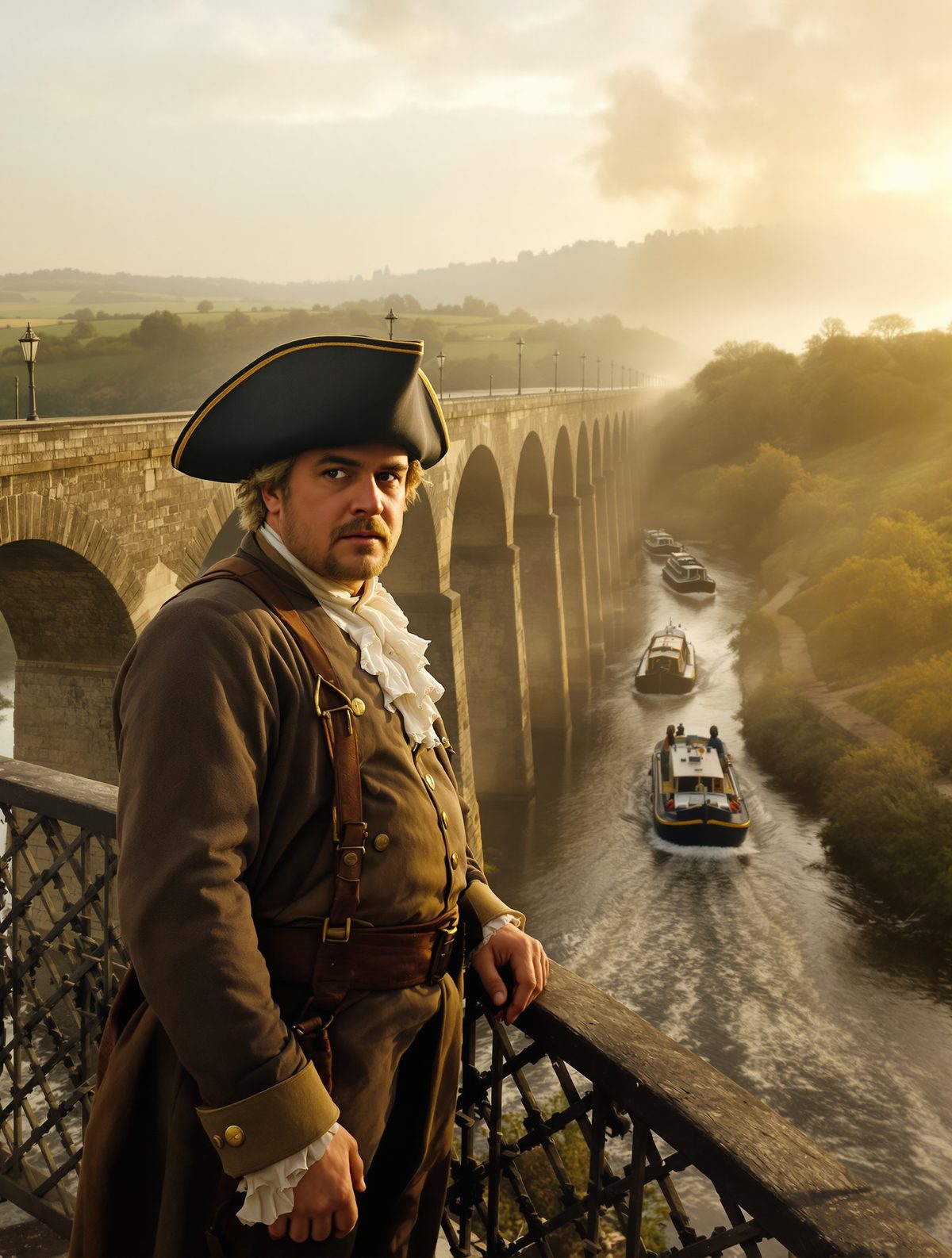
Picture this: a rough-hewn man in muddy boots stands before a gathering of powdered wigs and silk waistcoats, struggling to sign his own name with an X. The assembled gentlemen—engineers, aristocrats, men of learning—shake their heads in disbelief. This illiterate millwright claims he can dig a canal through ten miles of impossible terrain, float barges thirty-nine feet above a river, and revolutionize England's transport forever. They should have laughed him out of the room. Instead, they changed the world.
The year was 1759, and James Brindley was about to prove that genius doesn't require a grammar book.
The Impossible Dream of the Third Duke
Francis Egerton, the 3rd Duke of Bridgewater, had a problem that was costing him a fortune. His coal mines at Worsley, seven miles from Manchester, produced excellent coal, but getting it to market was a nightmare. Pack horses struggled along rutted roads, each animal carrying just two bags of coal. The journey took hours, the costs were crippling, and Manchester's growing factories desperately needed cheaper fuel.
The Duke had already spent £14,000—equivalent to millions today—on a failed attempt to make the rivers Irwell and Mersey navigable. Now he was contemplating something far more audacious: England's first true artificial waterway. Not an improved river, not a short cut between existing waterways, but a completely man-made canal carved from scratch.
His estate surveyor recommended a curious character: James Brindley, a 44-year-old millwright from Tunstead in Derbyshire. Brindley couldn't read blueprints because he couldn't read at all. He'd never built a canal because no one in England had. But he possessed something rarer than education—an almost supernatural ability to visualize water flow, gradients, and engineering solutions in his mind.
When Brindley walked the proposed route from Worsley to Manchester, he didn't take notes. He couldn't. Instead, he absorbed every contour, every obstacle, every possibility into his remarkable memory. Where others saw insurmountable problems, he saw elegant solutions.
The Man Who Thought in Water
James Brindley was that rarest of creatures—a working-class genius in an age when genius was supposedly the preserve of gentlemen. Born in 1716 to a small farmer in the Peak District, he'd been apprenticed at seventeen to a millwright named Abraham Bennett. Within years, the student had surpassed his master, developing an intuitive understanding of water power that bordered on the mystical.
Brindley's approach to engineering was utterly unique. When faced with complex problems, he would retreat to his bed for days, emerging only when he'd worked out every detail in his head. His mind was his drawing board, his memory his filing system. He once declared that "water was never designed by Providence to go uphill," yet he would soon make it do exactly that through a series of ingenious locks and aqueducts.
What made Brindley's illiteracy even more remarkable was his ability to communicate his visions to others. He would sculpt models from clay, build wooden prototypes, and use his hands to demonstrate concepts that educated engineers couldn't grasp from their elaborate drawings. His workers, many of them farmers and laborers like himself, understood his practical genius instinctively.
When the Duke of Bridgewater first met Brindley, he was struck not by the man's rough appearance, but by his absolute confidence. While learned engineers had declared the proposed canal impossible, this unlettered millwright calmly outlined how it could be done. The Duke, himself something of an outsider among the aristocracy, recognized a kindred revolutionary spirit.
Carving the Impossible
On July 26, 1761, James Brindley began digging what would become the Bridgewater Canal. The ten-mile route from Worsley to Manchester seemed straightforward on paper, but the reality was a symphony of geological nightmares. The canal had to traverse hills, valleys, rivers, and stretches of treacherous bog that had swallowed previous construction attempts.
Brindley's solution was characteristically unorthodox. Instead of following the contours of the land, he decided to maintain a level course—something that required digging through solid sandstone ridges and building embankments across deep valleys. His army of navvies, armed with nothing more than picks, shovels, and wheelbarrows, began the backbreaking work of moving thousands of tons of earth and rock.
The most spectacular challenge came at Barton, where the canal had to cross the River Irwell. Contemporary engineers suggested a series of locks to bring boats down to river level, then more locks to climb back up the other side. Brindley had a different idea entirely—one so audacious that even his supporters questioned his sanity. He would build an aqueduct, carrying the canal thirty-nine feet above the river in a stone-lined trough.
The Barton Aqueduct, completed in 1761, was unlike anything England had ever seen. Boats laden with coal floated serenely across the sky while river traffic passed beneath their keels. Contemporary observers described it as miraculous, impossible, a wonder of the age. Skeptics had predicted the structure would collapse under the weight of water and cargo. Instead, it stood as testimony to the power of practical genius over academic theory.
The Underground Marvel
But Brindley's masterpiece lay hidden beneath Worsley Hill. The canal didn't simply end at the coalface—it disappeared into the hillside itself, creating England's first underground navigation system. Brindley had carved a subterranean network of waterways that allowed coal barges to be loaded directly from the mine workings, eliminating the need for surface transport entirely.
This underground canal system, known as the Worsley Delph, eventually stretched for over forty miles beneath the Pennine hills. Narrow boats could penetrate deep into the mine workings, their holds filled with coal in dry, efficient conditions. The system included underground wharves, loading bays, and even stables for the horses that pulled the boats through the tunnels.
The engineering challenges were immense. Brindley had to maintain precise water levels throughout the underground system, ensure adequate ventilation for both horses and humans, and create drainage systems to prevent flooding. All of this was achieved without a single written calculation or technical drawing—just the extraordinary vision of an illiterate genius who could see solutions where others saw only problems.
The economic impact was immediate and dramatic. Coal that had cost eight pence per hundredweight to transport by packhorse now cost just four pence by canal. The Duke of Bridgewater's mining operation became fantastically profitable, and Manchester's industries gained access to cheap, reliable fuel that would power the Industrial Revolution.
Canal Mania and the Birth of Modern Transport
The success of the Bridgewater Canal triggered what historians call "Canal Mania"—a frenzy of waterway construction that transformed England's economic geography. By 1790, parliamentary approval had been granted for over 40 new canals, creating a network that would carry the nation's commerce for the next century.
Brindley found himself the most sought-after engineer in England, despite—or perhaps because of—his inability to read a technical manual. He went on to survey and design the Grand Trunk Canal, connecting the rivers Trent and Mersey and linking England's industrial heartland with its major ports. The 93-mile waterway, completed after his death, included the remarkable Harecastle Tunnel—1.75 miles of underground navigation that took eleven years to complete.
What made Brindley's approach revolutionary wasn't just his engineering solutions, but his fundamental philosophy of canal design. While continental engineers built canals that followed existing river valleys, Brindley created "contour canals" that maintained level courses across the landscape. This meant more tunnels, more embankments, more aqueducts—but also more efficient navigation and lower operating costs.
His influence extended far beyond engineering. The canal system he pioneered created new industries, new forms of employment, and new social classes. The "navvies" who dug his waterways became a legendary workforce, capable of moving mountains with hand tools and sheer determination. Canal boat families developed their own distinct culture, living and working on the narrow boats that carried Britain's commerce.
The Legacy of an Unlettered Genius
James Brindley died in 1772 at the age of 56, worn out by the demands of his extraordinary career. He never learned to read or write, yet his vision shaped the transport infrastructure of a nation. The canal network he pioneered remained the backbone of British commerce until the railway age, and many of his waterways continue to operate today—testament to the enduring quality of his engineering.
In our age of computer modeling and advanced materials, Brindley's achievements seem almost supernatural. How did a man with no formal education, no technical training, and no ability to read complex plans create engineering marvels that lasted centuries? The answer lies in a different kind of intelligence—one that combined practical experience, intuitive understanding, and sheer determination to achieve the impossible.
Perhaps most remarkably, Brindley's story reminds us that innovation doesn't require credentials—it requires vision. In an era when expertise is increasingly narrow and specialized, when artificial intelligence handles complex calculations, and when technical knowledge is measured in academic qualifications, the illiterate millwright who revolutionized transport stands as a powerful reminder that genius can emerge from the most unexpected places. Sometimes the person who changes the world is the one who doesn't know it's supposed to be impossible.