The sea was a writhing monster on the morning of September 7th, 1838. Hurricane-force winds screamed across the North Sea, hurling walls of black water against the jagged teeth of the Farne Islands. From her bedroom window in the Longstone Lighthouse, 22-year-old Grace Darling pressed her face to the rain-lashed glass and squinted into the apocalyptic dawn. What she saw would transform a quiet lighthouse keeper's daughter into Victorian England's most celebrated heroine – and launch a thousand legends.
There, barely visible through the tempest, dark shapes clung to the remnants of what had once been a proud steamship. The SS Forfarshire had been torn apart on the rocks like paper in a child's hands, and Grace could just make out human figures – impossibly small against the towering waves – fighting for their lives on a sliver of wreckage. Without hesitation, she turned to her father with words that would echo through history: "We must try to save them."
The Ship That Sailed Into Hell
The Forfarshire had been the pride of the Hull Steam Packet Company – a gleaming 400-ton paddle steamer that regularly plied the route between Hull and Dundee. On September 6th, 1838, she departed Hull with 62 souls aboard: passengers seeking passage to Scotland, crew members, and even a few hardy cargo handlers. Captain John Humble commanded the vessel, confident in both his ship and his decades of experience navigating these treacherous waters.
But the Forfarshire carried a deadly secret. Her boilers had been giving trouble for weeks, and as the ship pushed north into increasingly violent seas, the engine began to fail catastrophically. What started as reduced power became complete engine failure, leaving the steamship helpless in the grip of a strengthening gale. Without steam power, the Forfarshire became nothing more than a cork bobbing toward the most dangerous coastline in Britain.
Captain Humble fought desperately to maintain control, but by midnight the ship was being driven inexorably toward the Farne Islands – a constellation of rocky outcrops that had claimed hundreds of vessels over the centuries. At approximately 4 AM on September 7th, the inevitable happened. The Forfarshire struck Big Harcar rock with tremendous force, her hull splitting open like an eggshell.
Dawn of Disaster
The impact was catastrophic. Passengers who had been sleeping in their bunks were hurled from their beds as icy seawater flooded the lower decks. In the darkness and confusion, families were separated, children swept away, and strong swimmers found themselves powerless against the mountainous waves that crashed over the dying ship.
Within minutes, the Forfarshire had broken into two pieces. The forward section, containing the majority of passengers and crew, vanished beneath the waves almost immediately – taking 43 lives with it. But the stern section, by some miracle of physics and fortune, wedged itself onto the rocks and held fast. Nine terrified survivors found themselves clinging to this precarious refuge: five passengers and four crew members, including the ship's mate.
Among the survivors were Sarah Dawson, who had watched her two children disappear into the churning water, and the Reverend Robb, a Scottish minister whose faith would be tested as never before during the long hours that followed. They huddled together on the slippery deck plates, battered by spray, slowly succumbing to hypothermia, and watched with growing despair as rescue seemed impossible in such conditions.
The Lighthouse Keeper's Daughter
Grace Horsley Darling was no ordinary Victorian young woman. Born on November 24th, 1815, she had grown up in one of the most isolated and dangerous locations in Britain. Her father, William Darling, was the principal keeper of Longstone Lighthouse, and Grace had spent her entire life surrounded by the sea's moods – from gentle summer swells to winter storms that could shake the lighthouse to its foundations.
This upbringing had given her an almost supernatural ability to read the ocean's intentions. She could judge wind direction by the sound of the waves, estimate tide times by the rhythm of the surf, and – most crucially – handle a rowing boat in conditions that would terrify experienced sailors. While other young ladies of her era practiced watercolors and piano, Grace had mastered the art of threading a small boat between submerged rocks in a force-8 gale.
When she spotted the survivors at approximately 7 AM, Grace faced an agonizing dilemma. The storm was still raging at near-hurricane intensity, with waves reaching heights of 20 feet or more. The journey to Big Harcar rock would require navigating a maze of submerged obstacles while fighting both wind and tide. Even her father, with four decades of maritime experience, considered the rescue attempt borderline suicidal.
Into the Maelstrom
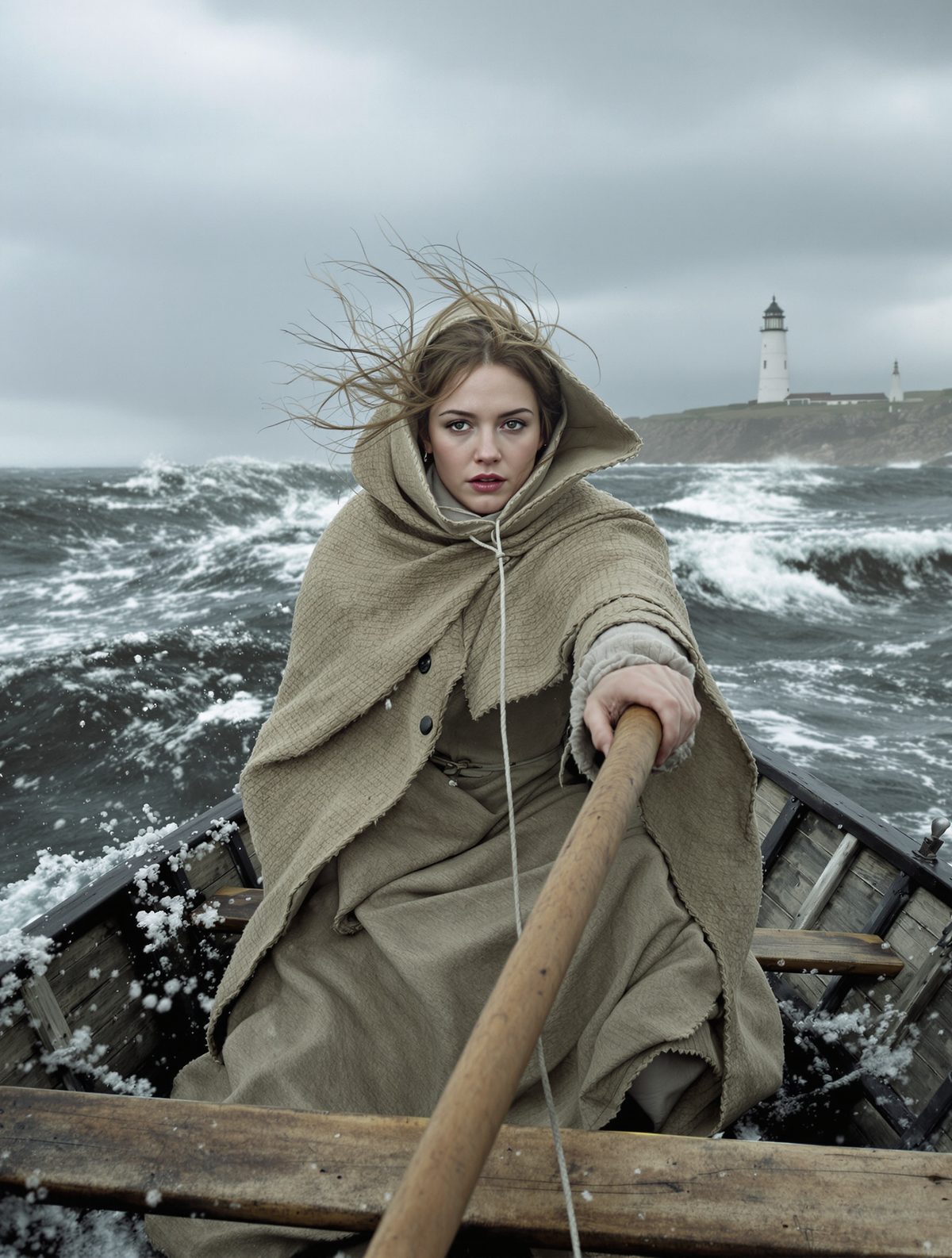
What happened next defied all logic and most laws of seamanship. Grace and her father launched their 21-foot coble – a traditional Northumbrian fishing boat – directly into what witnesses later described as the worst storm in living memory. The boat was immediately seized by towering waves that threatened to dash it against the lighthouse rocks before they had traveled fifty yards.
But Grace possessed something beyond mere skill: an intuitive understanding of how water moves around obstacles. She seemed to anticipate each wave's behavior, steering into valleys between swells and using the boat's momentum to climb mountainous walls of water. Her father worked frantically with a second set of oars, but later admitted that Grace's navigation was what kept them alive during those first terrifying minutes.
The journey to Big Harcar – normally a fifteen-minute row in calm conditions – took nearly an hour of back-breaking effort. Twice they were nearly swamped by breaking waves. Once, a particularly vicious gust almost capsized them entirely, saved only by Grace's lightning-fast reaction as she threw her weight to the high side and pulled hard on the oars to bring the bow back into the wind.
The survivors, who had given up hope of rescue in such conditions, could barely believe their eyes when Grace's small boat appeared through the spray. Sarah Dawson later wrote: "We saw this slip of a girl fighting the ocean itself, and we knew that angels must surely guide her oars."
Heroes in Petticoats
The rescue itself presented new challenges. The survivors were suffering from severe hypothermia and exhaustion – several could barely move, let alone assist in their own rescue. The coble could safely carry only four additional people in such conditions, meaning Grace and her father would need to make multiple trips through the hurricane.
Grace made a decision that revealed her remarkable presence of mind. She would remain with five of the survivors while her father took four back to the lighthouse, accompanied by two crew members who were still strong enough to help row. This meant Grace would spend two hours alone on the wreckage with people on the verge of death, keeping them conscious and alert while waves continued to pound their precarious refuge.
During this vigil, Grace used techniques that wouldn't seem out of place in a modern survival manual. She organized the survivors into a tight group to conserve body heat, kept them talking to prevent them from losing consciousness, and constantly repositioned them as the wreckage shifted with each wave. When the rescue boat returned, all five were still alive – a testament to Grace's improvised medical skills as much as her courage.
The Making of a Legend
News of Grace Darling's rescue spread across Britain with unprecedented speed. Within days, newspaper reporters were braving storms of their own to reach the isolated lighthouse. The story had everything Victorian society craved: a beautiful young heroine, dramatic rescue against impossible odds, and a satisfying triumph of human courage over natural disaster.
But the media attention came at a cost. Grace, who had never traveled more than a few miles from her lighthouse home, suddenly found herself the most famous woman in Britain. She received over 700 letters in the weeks following the rescue, including marriage proposals from complete strangers and requests for locks of her hair. The Duke of Northumberland presented her with a silver tea set, and Queen Victoria herself sent a personal commendation.
Perhaps most remarkably, Grace became one of the first women to receive significant financial rewards for heroism. Public subscriptions raised over £1,700 – equivalent to approximately £170,000 today – ensuring her family's financial security. This represented a revolutionary acknowledgment that women's courage was worth the same recognition as men's.
The Price of Fame
Grace never sought celebrity, and fame proved to be both blessing and curse. The constant stream of visitors to Longstone Lighthouse disrupted her family's quiet existence, and the pressure to make public appearances took a toll on her naturally shy disposition. She declined most invitations to leave the lighthouse, preferring to maintain her simple life helping her father with his duties.
Tragically, Grace's story was destined for a brief but brilliant arc. In 1842, just four years after her moment of glory, she developed tuberculosis – probably contracted from one of her many visitors. She died on October 20th, 1842, at the age of just 26, leaving behind a legend that would inspire countless others to acts of maritime heroism.
Today, Grace Darling's courage speaks to something timeless about human nature: the willingness of ordinary people to risk everything for strangers in need. In our age of professional rescue services and advanced technology, her story reminds us that heroism often comes down to a simple choice – to act when action seems impossible, to row into the storm when others would stay safely ashore. Grace Darling didn't just save nine lives that September morning; she saved our faith in the possibility that courage can triumph over any tempest.