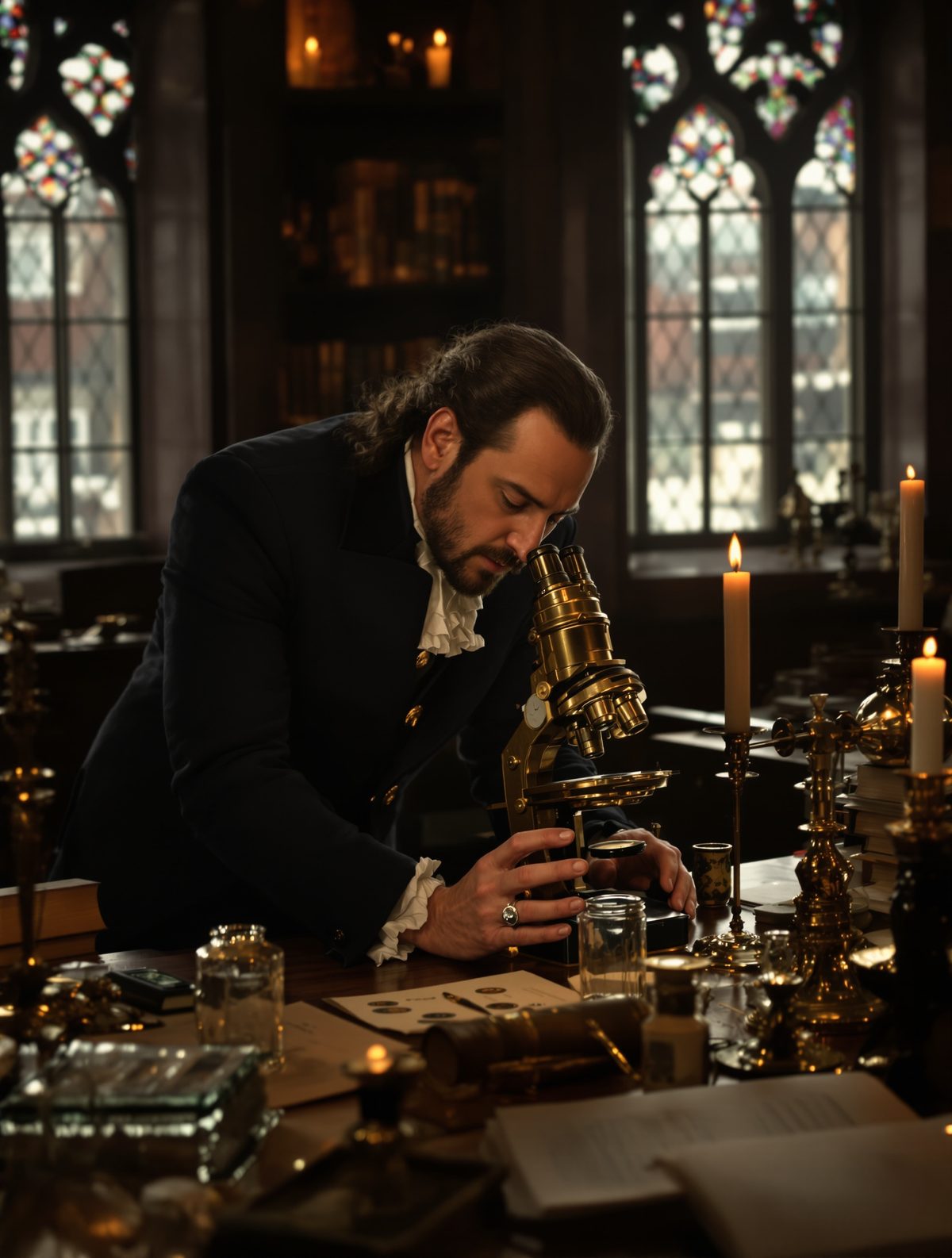
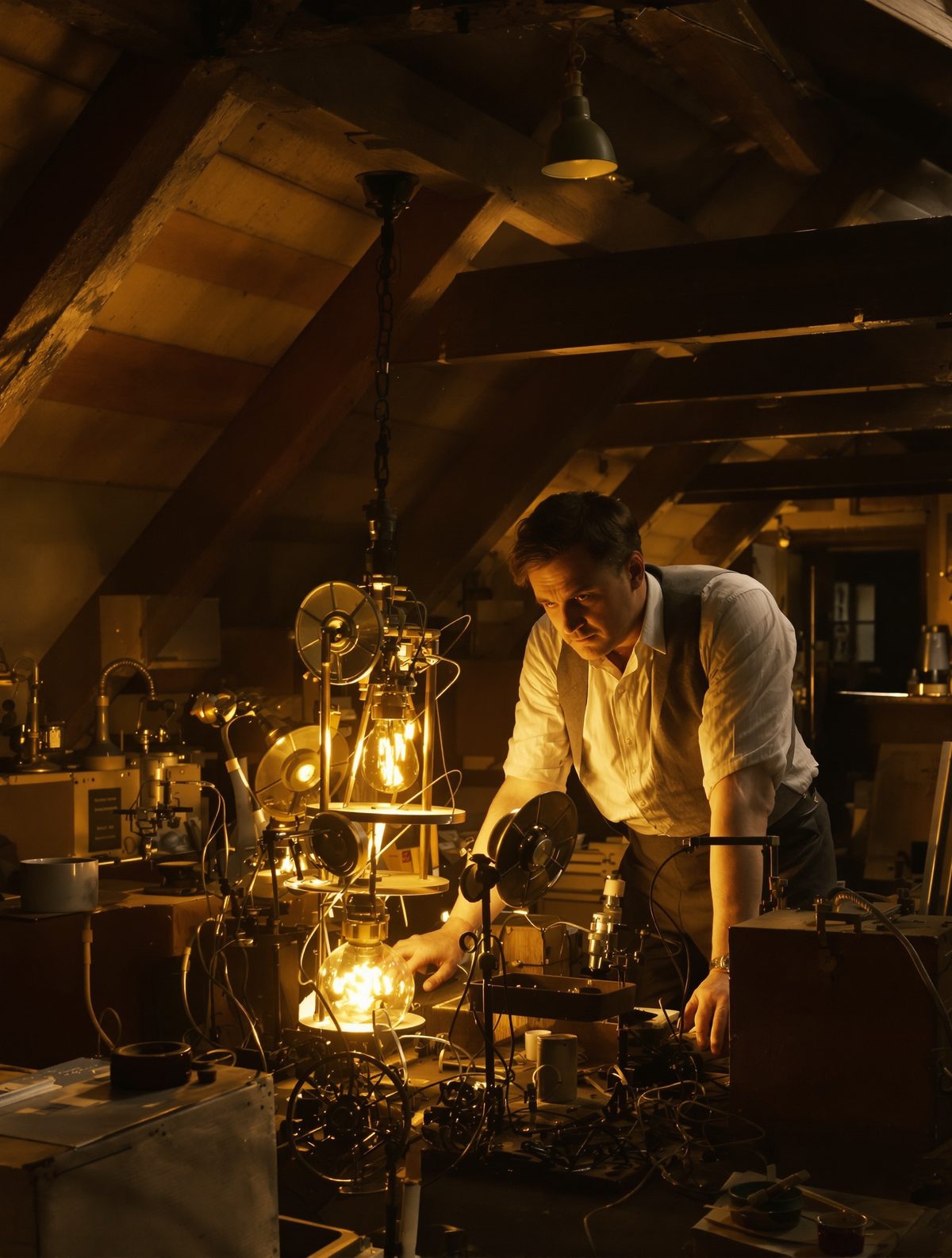
The autumn rain drummed against the grimy windows of 22 Frith Street, Soho, as John Logie Baird hunched over his peculiar contraption in the cramped attic above. It was October 2nd, 1925, and the 37-year-old Scottish inventor was about to make history with what looked like the contents of a junk shop explosion. Bicycle lamps cast eerie shadows across walls lined with biscuit tins, knitting needles jutted out at impossible angles, and somewhere in the middle of this mechanical chaos, a pair of scissors hung suspended by string. To any sane observer, Baird appeared to be a madman tinkering with rubbish. In reality, he was on the verge of transmitting the world's first recognizable television image.
As he adjusted the rotating cardboard disc—punctured with holes in a precise spiral pattern—Baird had no idea that in the next few moments, he would achieve something that scientists at major corporations had been attempting for years. The flickering, ghostly face that was about to appear on his tiny screen would herald the dawn of an age that would transform human civilization forever.
The Makeshift Magician of Frith Street
John Logie Baird was hardly the obvious candidate to revolutionize global communication. Born in Helensburgh, Scotland, in 1888, he had already failed spectacularly at several business ventures, including attempting to manufacture jam and soap. His health was fragile—he suffered from poor circulation and chronic fatigue that would plague him throughout his life. By 1922, when he arrived in the seaside town of Hastings with little more than his engineering diploma from the Royal Technical College in Glasgow, Baird was virtually penniless.
But what he lacked in resources, he made up for in stubborn Scottish determination and an almost supernatural ability to see potential in discarded objects. While Thomas Edison worked in well-funded laboratories and major corporations poured thousands into research, Baird was performing miracles with materials that wouldn't have looked out of place in a child's school project.
His television apparatus was a testament to ingenious improvisation. The scanning disc—the heart of his system—was cut from cardboard and mounted on a coffin lid he'd acquired from an undertaker. Bicycle lamps provided illumination, while biscuit tins served as the framework. Most remarkably, he used knitting needles as axles and old electric motors salvaged from wherever he could find them. The entire contraption was held together with sealing wax, string, and what can only be described as sheer bloody-mindedness.
The Moment Everything Changed
On that drizzly October afternoon, Baird positioned a ventriloquist dummy's head—which he had somewhat morbidly nicknamed "Stooky Bill"—in front of his transmitter in one corner of the room. Stooky Bill, with his painted face and glassy stare, was about to become television's first star, though he would never know it.
The principle behind Baird's system was elegantly simple, even if the execution looked chaotic. His mechanical scanner would break down the image of Stooky Bill into a series of light and dark spots, converting these into electrical signals. These signals would then travel across the room to his receiver, where another spinning disc would reconstruct the image line by line on a small screen.
For months, Baird had been achieving only shadows and silhouettes—tantalizing hints that his theory was sound, but nothing that could truly be called television. Then, as he fine-tuned the synchronization between his transmitter and receiver discs, something extraordinary happened. The fuzzy, indistinct blur on his receiver screen suddenly sharpened into something recognizable: Stooky Bill's face, complete with discernible features, staring back at him through the electronic ether.
Baird later wrote that he could hardly believe what he was seeing. The image was crude—just 30 lines of resolution compared to today's high-definition displays—but it was unmistakably a face. More importantly, when he moved Stooky Bill's head, the image on the screen moved in perfect synchronization. He had achieved true television transmission.
From Dummy to Human: The First Living Television Star
Overcome with excitement, Baird realized he needed a human witness to this historic moment. He thundered down the narrow staircase to the office below, where he burst in on a startled office boy named William Edward Taynton. The 20-year-old was initially reluctant—Baird's wild appearance and frantic explanations about "seeing faces through the air" probably didn't inspire confidence in his sanity.
Legend has it that Baird had to offer the young man half a crown—a substantial sum in 1925—to convince him to come upstairs and sit in front of the strange contraption. Taynton's wariness proved well-founded: the intense heat from the bicycle lamps was almost unbearable, and he could only tolerate a few minutes under their glare.
But those few minutes were enough to make history. William Edward Taynton became the first human being ever to appear on television, his flickering visage transmitted across Baird's cluttered attic laboratory. The image quality was poor—contemporary accounts describe it as resembling "a ghost walking through fog"—but facial features were clearly distinguishable. Baird could see Taynton's eyes, nose, and mouth with startling clarity.
What makes this moment even more remarkable is that neither man fully grasped the magnitude of what they had just achieved. Taynton pocketed his half crown and returned to work, probably thinking he had just helped a harmless eccentric with his peculiar hobby. He had no way of knowing he had just participated in one of the most significant technological breakthroughs in human history.
The World Takes Notice (Eventually)
Convincing the world that he had actually invented television proved more challenging than the invention itself. Baird's first public demonstration, held at Selfridge's department store in London in April 1925, generated more curiosity than serious scientific interest. Shoppers would pause to watch the flickering shadows on his small screen, but few understood the revolutionary implications of what they were seeing.
The scientific establishment was even more skeptical. When Baird contacted the Daily Express newspaper to announce his breakthrough, the editor famously replied: "For God's sake, go down to Reception and get rid of a lunatic who's down there. He says he's got a machine for seeing by wireless!" The Royal Institution initially refused to take his work seriously, and many established scientists dismissed his mechanical scanning system as a dead end.
Their skepticism wasn't entirely unfounded. Baird's early television images were crude by any standard—grainy, flickering, and prone to disappearing entirely if the mechanical components fell out of synchronization. The viewing screen was tiny, about the size of a postcard, and the picture quality was so poor that viewers needed considerable imagination to make out what they were supposedly seeing.
However, Baird's persistence eventually paid off. On January 26, 1926, he gave a demonstration to members of the Royal Institution that finally convinced the scientific community he had achieved genuine television transmission. Among the witnesses was the editor of The Times, who wrote: "The image as transmitted was faint and often blurred, but substantiially a true reproduction of the face and movements of the person being transmitted."
Beyond the Attic: Television's Rapid Evolution
From his humble beginning in the Frith Street attic, Baird's success accelerated rapidly. In 1927, he transmitted the first television signal between London and Glasgow—a distance of 438 miles—proving that his system could work over long distances via telephone lines. The following year, he achieved the first transatlantic television transmission, sending images from London to New York.
Perhaps most remarkably, Baird didn't stop at black and white television. In 1928, he demonstrated the world's first color television transmission, and by 1929, he was experimenting with stereoscopic 3D television—technologies that wouldn't become commercially viable for decades.
The BBC began the world's first regular television service using Baird's system in 1929, though it was limited to just 30 minutes twice a week. The images were still crude, but they were television images nonetheless, transmitted into people's homes across Britain. By 1936, the BBC was broadcasting regular programming, though they eventually adopted a competing electronic system that offered superior picture quality.
Baird's mechanical television system would ultimately be superseded by electronic alternatives, but his achievement in that cluttered London attic had opened the door to possibilities that even he couldn't have imagined.
The Scottish Tinkerer's Digital Legacy
Today, as we stream high-definition video to devices that would have seemed like pure magic to Baird, it's worth remembering that it all began with bicycle lamps, biscuit tins, and knitting needles in a rented attic. The direct line from Stooky Bill's ghostly visage to today's global digital networks represents one of the most dramatic technological transformations in human history.
Baird's story reminds us that revolutionary breakthroughs don't always emerge from well-funded corporate laboratories or prestigious universities. Sometimes, they spring from the stubborn determination of individuals willing to see possibilities where others see only junk, and to persist when conventional wisdom insists they're chasing impossible dreams.
In an age when we take instant global communication for granted, perhaps we need more of John Logie Baird's makeshift magic—the willingness to experiment, to fail, and to keep tinkering until something extraordinary emerges from the chaos. After all, the next world-changing invention might be taking shape right now in someone's cluttered attic, built from whatever happens to be lying around.