
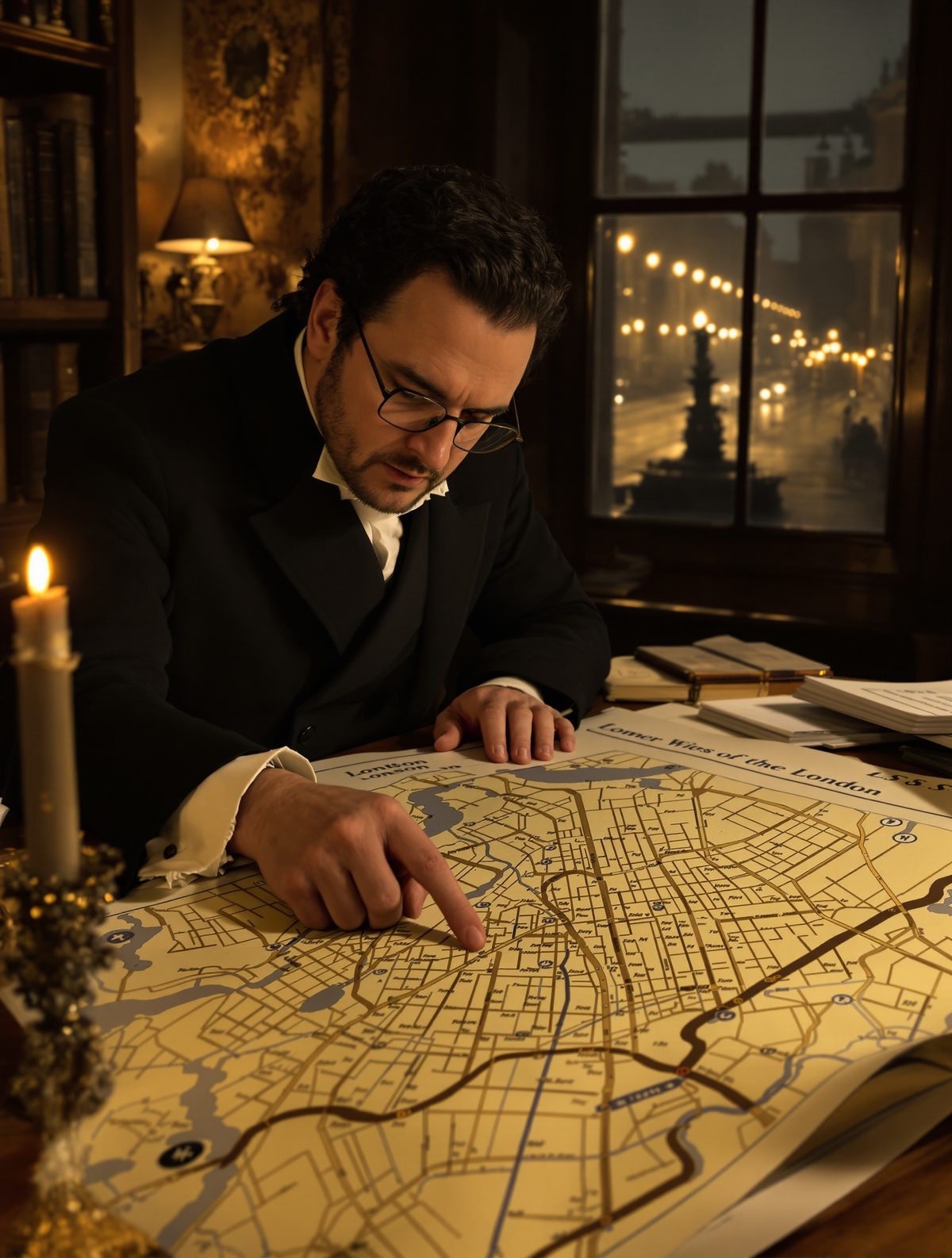
The stench hit you first. In the sweltering heat of September 1854, London's Soho district reeked of human waste, rotting vegetables, and death. Within a single block of Broad Street, seventy people had died in four days. Neighbors whispered that the very air itself had turned poisonous, carrying an invisible killer that could fell a healthy man in hours. But one physician, hunched over a crude map in his study, was about to prove them all wrong—and in doing so, would save thousands of lives with nothing more than a few pen marks and the removal of a single water pump handle.
When Death Moved Faster Than Fear
Dr. John Snow had seen cholera before, but nothing like this. The outbreak that began on August 31, 1854, moved through Soho's cramped streets with terrifying speed. Victims would wake feeling fine, complain of stomach cramps by midday, and be dead by nightfall. The disease didn't discriminate—it claimed prosperous shopkeepers and desperate street sweepers with equal voracity.
The statistics were staggering: in the first ten days of September, over 500 residents of this small London neighborhood had perished. Entire families were wiped out. Houses stood empty, their doors marked with chalk crosses. Those who could afford to flee had already done so, leaving behind a community paralyzed by terror.
The medical establishment had a ready explanation: miasma, or "bad air." This poisonous vapor, they claimed, rose from sewers and cesspits, carrying disease on invisible wings. It was a theory that made perfect sense—after all, the poorest, filthiest areas always suffered the worst outbreaks. The solution seemed obvious: avoid the stench, purify the air, and wait for the epidemic to burn itself out.
But John Snow wasn't convinced. A 41-year-old physician with an unusual background—he'd started life as a surgeon's apprentice in rural Newcastle—Snow had spent years studying cholera. What he'd observed didn't match the miasma theory. If bad air was the culprit, why did the disease sometimes skip houses entirely, claiming victims on one side of a street while leaving their neighbors untouched?
The Map That Changed Everything
While his colleagues debated atmospheric conditions, Snow was doing something revolutionary: he was plotting death. Using a simple map of Soho, he began marking the location of every cholera fatality with a thick black bar. One bar for each death, stacked like a macabre game of pick-up sticks wherever the disease had struck.
What emerged was extraordinary. The deaths weren't scattered randomly across the neighborhood—they formed a distinct pattern. The highest concentration of black bars clustered around a single point: the public water pump at the intersection of Broad Street and Cambridge Street (now Broadwick Street and Lexington Street).
Snow's map revealed something the miasma theorists had missed entirely. Houses closest to the Broad Street pump showed the densest clusters of death. As the distance from the pump increased, the number of fatalities dropped dramatically. It was as if someone had dropped a stone of disease into still water, creating ripples of death that grew weaker with distance.
But the pattern wasn't perfect, and it was the exceptions that proved Snow's theory. A workhouse on Poland Street, just 200 yards from the pump, had suffered only five deaths among its 535 inmates. Why? Because it had its own private well. The Broad Street Brewery, even closer to the pump, had lost none of its 70 workers. The reason? The brewery workers were given a daily beer ration and rarely drank water at all.
The Widow and the White Cloth
Snow's investigation revealed one of history's most tragic patient zeros. Susannah Lewis, a widow living at 40 Broad Street, had lost her five-month-old daughter to cholera on August 28th. In her grief, she had done what any mother would do—she had washed her baby's soiled clothing and bedding. The dirty water, contaminated with cholera bacteria, was thrown into a leaking cesspit just three feet from the Broad Street pump.
The white cloth that had wrapped an innocent child became the weapon that would kill hundreds. The contaminated waste seeped through London's porous soil, mingling with the water that thousands of residents drew daily from the pump. Every bucket filled, every cup drunk, spread the invisible killer further through the community.
What made this discovery even more remarkable was how Snow pieced it together. He didn't have modern laboratories or microscopes capable of detecting bacteria. The cholera vibrio wouldn't be discovered for another thirty years. Instead, he had only his observations, his map, and his willingness to challenge accepted medical wisdom.
The widow Lewis had unknowingly created what we now know as a perfect storm for disease transmission. The pump was popular not just with local residents, but with workers from across London who preferred its water to the foul-tasting alternatives available elsewhere. Some would travel considerable distances specifically to collect water from Broad Street, carrying the infection back to their own neighborhoods.
The Handle That Stopped an Epidemic
Armed with his evidence, Snow approached the Board of Guardians of St. James's Parish on September 7, 1854. His request was simple but radical: remove the handle from the Broad Street pump. Make it impossible for people to draw water from what he was certain was the source of the outbreak.
The officials were skeptical. Snow's water theory flew in the face of everything the medical establishment believed. How could something as pure and essential as water—especially water that looked and tasted fine—be carrying death? The miasma theory made more sense; everyone could smell the problem.
But the death toll was mounting, and conventional approaches had failed. Reluctantly, the parish authorities agreed to Snow's unusual request. On September 8, 1854, they removed the pump handle.
The effect was dramatic. New cholera cases, which had been claiming dozens of lives daily, began to decline almost immediately. Within days, the epidemic that had terrorized Soho was effectively over. Snow's map and his simple intervention had succeeded where all the medical expertise of Victorian London had failed.
Of course, Snow's critics were quick to point out that the epidemic might have been waning naturally. Cholera outbreaks did tend to burn themselves out, and by early September, many of the neighborhood's residents had already fled or died. But the timing was too perfect to ignore, and Snow's detailed documentation would prove invaluable to future epidemiologists.
The Doctor Who Was Right Too Soon
You might expect that Snow's triumph would have made him a hero of Victorian medicine. Instead, he found himself more isolated than ever. The medical establishment wasn't ready to abandon the miasma theory, especially not for the radical idea that disease could spread through water. The concept of germs was still decades away from acceptance.
The government's official inquiry into the cholera outbreak, published in 1855, dismissed Snow's findings entirely. The committee concluded that the epidemic was caused by atmospheric conditions and that the removal of the pump handle had been irrelevant to its end. Snow was painted as a well-meaning but misguided physician whose theories lacked scientific credibility.
Snow continued to refine his research, publishing expanded studies that tracked cholera transmission across London's various water companies. He showed that areas supplied by companies drawing water from sewage-contaminated sections of the Thames suffered higher death rates than those using cleaner sources. But his work remained largely ignored by his contemporaries.
When John Snow died in 1858 at the age of 45, he was remembered primarily for his innovations in anesthesia—he had administered chloroform to Queen Victoria during childbirth—rather than for his groundbreaking epidemiological work. It would be another twenty years before the medical community began to take his cholera research seriously, and thirty years before the discovery of the cholera bacterium proved him definitively right.
The Map That Changed Medicine Forever
Today, John Snow is celebrated as the father of modern epidemiology, and his Broad Street pump investigation is taught in medical schools worldwide. His innovation—using geographic mapping to track disease patterns—became a fundamental tool of public health. Every time researchers plot the spread of a new disease outbreak, they're following in Snow's footsteps.
The pump itself has become a pilgrimage site for public health professionals. A replica stands near the original location on what is now Broadwick Street, and the John Snow pub nearby serves as an informal shrine to the man who proved that sometimes the most profound truths can be found not in grand theories, but in careful observation of simple patterns.
In our modern age of global pandemics and instant communication, Snow's story carries a particularly relevant message. The next time experts confidently explain the cause of a crisis, remember the Victorian physicians who were so certain that bad air was killing London's poor. Sometimes the most important breakthroughs come from those willing to question conventional wisdom, armed with nothing more than careful observation and the courage to see patterns that others have missed. In a world where misinformation can spread as quickly as any disease, we need more people like John Snow—ready to map the truth, one data point at a time.