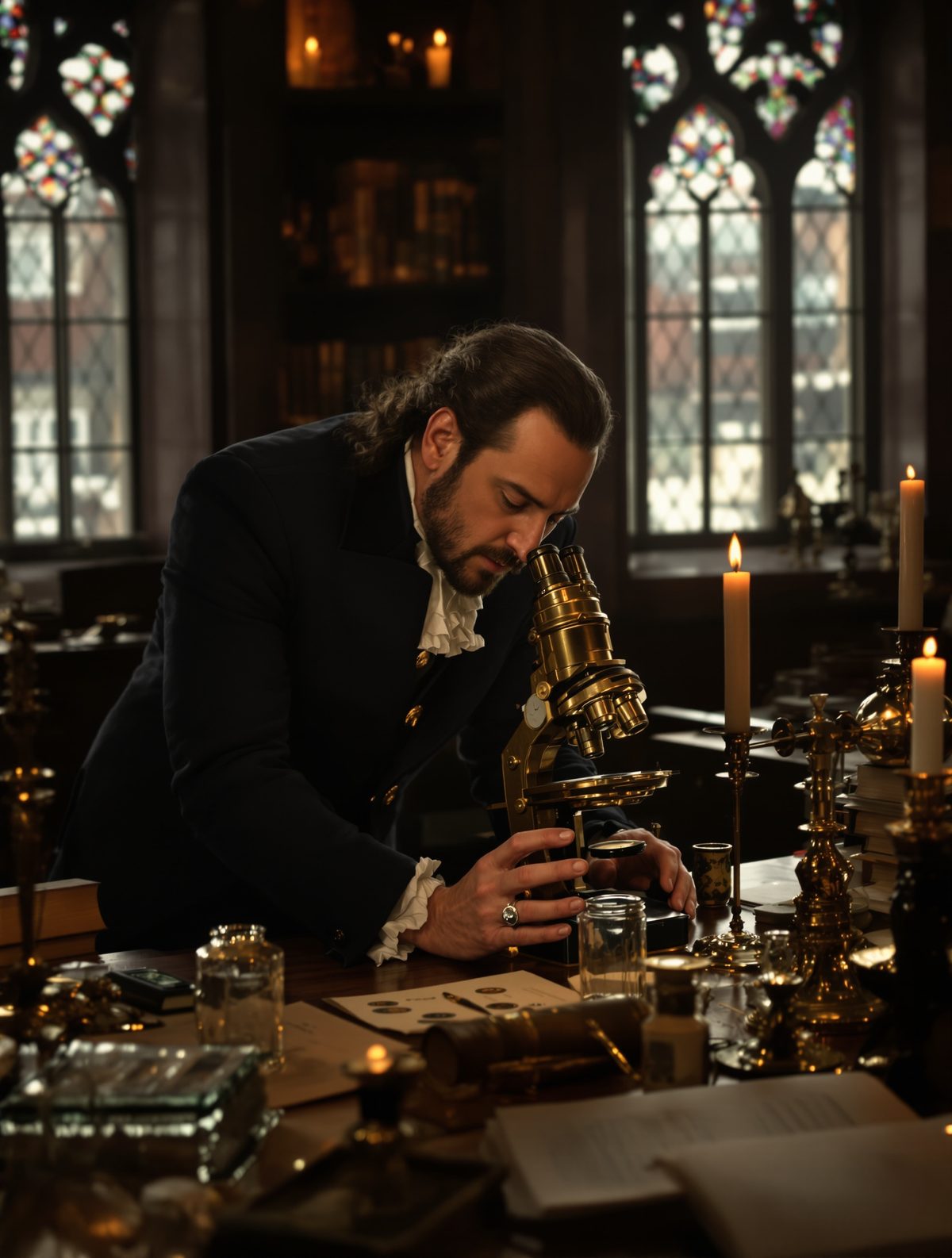
In the flickering candlelight of a cluttered London laboratory, a man squinted through a brass tube no bigger than his fist. The year was 1665, and Robert Hooke was about to peer into a world that had remained invisible since the dawn of creation. What he saw through those primitive lenses would give science one of its most fundamental concepts—and humanity a completely new way of understanding life itself.
The piece of cork in his hand looked unremarkable. Wine merchants discarded thousands like it every day across London's taverns. But as Hooke adjusted the focus of his handcrafted microscope, something extraordinary materialized in that tiny slice of tree bark. Row upon row of perfect little chambers, like the cells of a monastery or the rooms of some miniature palace. He had discovered what he would call "cells"—though he had no idea he was looking at the basic building blocks of all living things.
The Curious Mind in a Plague-Torn City
London in 1665 was a city under siege—not by armies, but by the Great Plague. As death carts rumbled through cobblestone streets and families barricaded themselves indoors, Robert Hooke found refuge in his laboratory at Gresham College. The 30-year-old curator of experiments for the Royal Society had always been obsessed with seeing the unseen, but the plague year gave him unprecedented time to pursue his investigations.
Hooke was no ordinary scientist. Born the son of a country vicar on the Isle of Wight, he had clawed his way up through sheer brilliance and an insatiable curiosity about everything around him. By day, he served as Christopher Wren's right-hand man, surveying London after the Great Fire. By night, he retreated to his laboratory, surrounded by barometers, telescopes, watches, and his crown jewel—a microscope that could magnify objects up to 50 times their original size.
This may not sound impressive by today's standards, but in 1665, it was like having supernatural vision. While his contemporaries squinted at specimens with simple magnifying glasses, Hooke had created a compound microscope with multiple lenses that revealed details no human had ever imagined existed.
The Revolutionary Moment
On that fateful day—likely sometime in early 1665, though Hooke's diary doesn't record the exact date—he selected his specimen almost at random. Cork was readily available, easy to slice thin, and light enough for his primitive illumination system to penetrate. Using a sharp penknife, he cut the thinnest possible shaving and placed it under his lens.
What happened next changed everything. As Hooke later wrote, the cork appeared "all perforated and porous, much like a Honey-comb." But these weren't random holes. They were organized, structured, purposeful. Each tiny chamber was surrounded by what appeared to be solid walls, creating a pattern so regular and beautiful that it seemed almost architectural.
The chambers reminded Hooke of something specific—the small rooms or "cells" where monks lived in monasteries. It was this resemblance that led him to coin the term that would become fundamental to biology. Of course, Hooke was actually looking at the empty cell walls left behind after the cork tree's living cells had died, but his terminology stuck. He had no way of knowing that similar structures existed in every living thing on Earth, from the smallest bacteria to the largest whales.
But here's what makes this discovery even more remarkable: Hooke didn't stop with cork. Driven by an almost manic curiosity, he began examining everything he could get his hands on—feathers, fish scales, insects, leaves, even his own hair and fleas from his dog. Each specimen revealed new wonders, new structures that no one had ever suspected existed.
The Book That Shocked the World
Hooke knew he had stumbled onto something extraordinary, but being a meticulous scientist, he spent months documenting his findings. The result was "Micrographia," published in January 1665—one of the most influential scientific books ever written. But calling it just a "scientific book" hardly does it justice.
Micrographia was a sensation. Priced at 30 shillings—about £200 in today's money—it sold out immediately. Samuel Pepys, the famous diarist, called it "the most ingenious book that I ever read in my life" and stayed up until 2 AM reading it. The book's 60 detailed engravings, drawn by Hooke himself, showed Londoners a hidden universe that existed right under their noses.
The most famous illustration was a fold-out drawing of a flea, magnified to enormous proportions. Readers were astonished to see that this tiny pest had elaborate armor, jointed legs, and complex eyes. Suddenly, the smallest creatures weren't just nuisances—they were intricate machines of incredible complexity. One contemporary wrote that the book made him feel "as if I had been admitted into a new world."
But it was Hooke's drawing of cork cells—appearing as Observation XVIII in the book—that would have the most lasting impact. His precise illustration showed the regular, box-like structures that he described as looking "like a honey-comb." Little did he know he was drawing the fundamental unit of life itself.
The Hidden Revolutionary
Here's where the story gets fascinating in ways most people never learn. Robert Hooke should be as famous as Isaac Newton, but history has largely forgotten him—partly because he had the misfortune of being Newton's bitter rival. The two men feuded over everything from gravity to optics, and since Newton lived longer and had more powerful friends, Hooke's contributions were systematically minimized.
But Hooke's achievements were staggering. Beyond discovering cells, he formulated Hooke's Law of elasticity (still taught in physics classes today), invented the universal joint used in car transmissions, designed some of London's most beautiful buildings, created the first weather monitoring system, and even proposed that fossils were evidence of extinct species—a radical idea that predated Darwin by 200 years.
In the world of microscopy, Hooke was pioneering techniques that wouldn't become standard for decades. He experimented with different lighting methods, created his own specimen preparation techniques, and even figured out how to observe living specimens—watching pond water teem with tiny creatures he called "animalcules."
Perhaps most remarkably, Hooke came tantalizingly close to understanding what cells actually were. In later observations of living plant tissues, he noticed that the cells were filled with "juices" and seemed to be the basic units from which larger structures were built. He was edging toward the revolutionary concept that all living things are made of cells—an insight that wouldn't be formally recognized until the 1830s.
The Invisible Made Visible
What makes Hooke's story so compelling isn't just what he discovered, but how he discovered it. Working alone in a candlelit room, using instruments he built with his own hands, he pushed the boundaries of human perception further than they had ever gone. His microscope was a marvel of craftsmanship—a brass tube containing multiple lenses that he had ground and polished himself, mounted on an adjustable stand that allowed for precise positioning.
The technical challenges were immense. Creating clear, distortion-free lenses required skills that were part science, part art. Hooke had to master glassmaking, metalworking, and optics simultaneously. His illumination system used a combination of candles, mirrors, and water-filled glass spheres to focus light on specimens without destroying them with heat.
Even more impressive was his artistic ability. Every illustration in Micrographia was drawn by Hooke himself, directly from his microscopic observations. He had to develop new techniques for representing three-dimensional microscopic structures on flat paper, creating images so accurate that modern scientists still marvel at their precision.
A Legacy Written in Every Living Thing
Today, as you read these words, approximately 37 trillion cells are working together to keep you alive. Every breath, every heartbeat, every thought depends on the microscopic machinery that Hooke first glimpsed in that piece of cork nearly 360 years ago. The word he coined in a moment of inspiration—"cell"—is now spoken in every language on Earth by students, doctors, researchers, and teachers.
But Hooke's true legacy goes beyond terminology. He inaugurated an entirely new way of understanding life—not as some mysterious force, but as an incredibly complex system built from tiny, observable components. His work laid the groundwork for everything from modern medicine to genetic engineering. When scientists today manipulate individual cells to cure diseases or create new materials, they're building on foundations that Hooke established in that plague-darkened London laboratory.
Perhaps most importantly, Hooke embodied the spirit of discovery that would define the Scientific Revolution. He refused to accept that anything was too small to matter or too mysterious to investigate. In a world where most people still believed in spontaneous generation and divine mysteries, he insisted that nature's secrets could be unlocked through careful observation and ingenious instruments.
The next time you look at a piece of cork—perhaps from a wine bottle—remember that you're holding one of science's most important historical artifacts. In its simple, honeycomb structure lies the beginning of our modern understanding of life itself, discovered by a curious man who dared to look closer than anyone had looked before.