
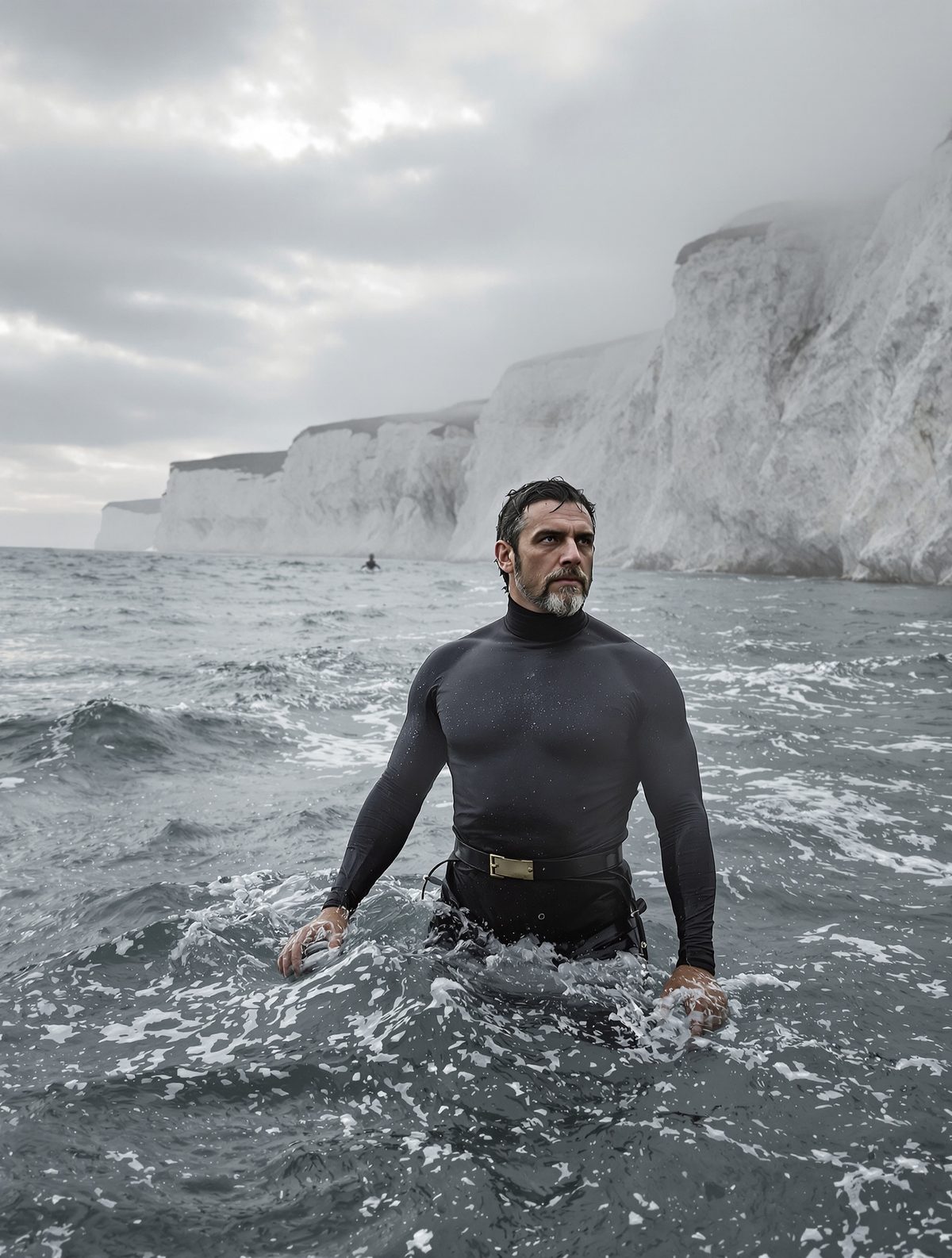
The grey waters of the Dover Strait lapped against the shingle beach as a stocky man in a red silk costume stepped into the surf. It was 12:56 PM on August 25th, 1875, and Captain Matthew Webb was about to attempt something that had never been done before—and something many believed was physically impossible. Behind him, a small crowd of spectators watched with a mixture of curiosity and skepticism. Ahead lay twenty-one miles of treacherous water, deadly currents, and the kind of challenge that would either make him famous or kill him trying.
What happened next would change swimming history forever and establish Webb as one of Victorian Britain's most unlikely heroes. But the story of that extraordinary day—and the equally extraordinary man who made it possible—reveals far more about courage, obsession, and human endurance than any textbook has ever told.
The Captain Who Couldn't Swim (Properly)
Matthew Webb was an unlikely candidate for aquatic immortality. Born in Coalbrookdale, Shropshire, in 1848—the heart of Britain's industrial revolution—he learned to swim in the River Severn as a boy. But his technique was, by modern standards, almost comically primitive. Webb employed what was then called the "breaststroke," keeping his head perpetually above water and using a frog-like motion that would make today's Olympic coaches weep.
Yet what Webb lacked in technique, he more than made up for in sheer bloody-minded determination. As a merchant sea captain, he'd already proven his mettle in 1874 when he dove into the mid-Atlantic to attempt (unsuccessfully) to rescue a man overboard. The incident earned him a medal and £100 from the Royal Humane Society, but more importantly, it planted a seed of an idea.
The English Channel had been taunting swimmers for decades. J.B. Johnson had tried and failed in 1872. Paul Boyton had crossed it in 1875, but he'd used an inflatable rubber suit that was more boat than swimming aid. Webb wanted to do it properly—just man versus sea, with nothing but porpoise oil for protection against the cold.
The First Failure That Nearly Killed Him
Webb's first serious attempt came on August 12th, 1875—just thirteen days before his eventual triumph. What followed was a disaster that should have ended his Channel dreams forever. After six and a half hours in increasingly rough seas, Webb was hauled from the water, hypothermic and defeated, having been swept backwards by the notorious Dover currents.
Any sensible person would have abandoned the idea. The Dover Express wrote him off as a foolish dreamer, and even his supporters questioned whether the human body could endure such punishment. But Webb wasn't interested in being sensible. Within days, he was back in Dover, studying tidal charts and weather patterns with the intensity of a military strategist planning a campaign.
His trainer, Frederick Beckwith, thought he was mad. The local fishermen, who knew the Channel's moods better than anyone, shook their heads. Even Webb's financial backers—he'd managed to attract some sponsorship from local businessmen—began to have second thoughts. But Webb had seen something in those six brutal hours that others missed: it was possible, but only if everything went perfectly.
21 Hours and 45 Minutes of Hell
The conditions on August 25th were far from perfect, but they were the best Webb was going to get. A light wind from the northeast, relatively calm seas, and—crucially—a tide that would work with him rather than against him during the critical middle hours.
Webb's support team was minimal by today's standards: a single pilot boat captained by Matthew Chappell, a handful of observers, and his trainer Beckwith armed with beef tea, brandy, and encouragement. As Webb struck out from Admiralty Pier, the small flotilla followed at a respectful distance, knowing that any physical assistance would invalidate the attempt.
The first few hours went relatively well. Webb maintained a steady rhythm of around twenty strokes per minute, his primitive breaststroke eating up the yards if not the miles. But as afternoon turned to evening, the real challenges began. Jellyfish stings peppered his arms and face. His support team later counted dozens of angry red welts across his body.
Then came the cramps. Around hour eight, Webb's legs began to seize with the kind of muscle spasms that would have ended most swimmers' attempts. But when Beckwith offered to pull him from the water, Webb's response was unprintable—though it was definitely a refusal. Instead, he grabbed a flask of brandy thrown from the boat, took a swig, and kept swimming.
The night hours were the worst. In complete darkness, with only the oil lamps of his support boat for guidance, Webb battled not just physical exhaustion but the psychological horror of being alone in black water. He later described hallucinations—seeing phantom ships and hearing voices calling his name from the depths.
The Breakfast That Made History
Dawn on August 26th revealed a bizarre sight: a man who had been swimming for over eighteen hours, still mechanically lifting and lowering his arms while his support crew prepared breakfast. And what a breakfast it was—beef tea, brandy, coffee, and an entire bottle of ale, all consumed while treading water in mid-Channel.
This floating feast revealed one of Webb's most remarkable secrets: he had trained his body to eat and drink while swimming, a skill that would not become standard among long-distance swimmers for decades. Local newspapers later made much of his mid-swim alcohol consumption, with temperance societies condemning his example. They missed the point entirely—Webb was using alcohol as medicine, not recreation, to keep his core temperature stable and his spirits up.
By 9 AM, the French coast was finally visible, but Webb's ordeal was far from over. The Dover currents had swept him far to the east, and he was heading for the treacherous rocks near Calais rather than the sandy beaches he'd hoped for. With his strength nearly gone and his stroke rate down to barely ten per minute, Webb faced a cruel irony: he might die within sight of his goal.
Triumph, Fame, and the Price of Glory
At 10:41 AM on August 26th, 1875, Captain Matthew Webb staggered onto the beach at Calais, collapsing onto French sand after 21 hours and 45 minutes in the water. He had covered approximately 39 miles due to the zigzag course forced on him by tides and currents—nearly twice the direct distance.
The reaction was immediate and extraordinary. Telegraph wires hummed with news of his achievement. Queen Victoria sent personal congratulations. The French gathered on the beach, amazed by this English eccentric who had conquered their shared sea. Within days, Webb was a celebrity on both sides of the Channel.
But fame came at a terrible price. Webb became addicted to increasingly dangerous swimming stunts, chasing the high of public adulation. He swam the Thames through London, battled the Niagara Rapids, and performed in music halls. Each feat was more perilous than the last, as if he was trying to recapture that perfect moment when he first touched French sand.
The end, when it came in 1883, was both tragic and inevitable. Webb drowned attempting to swim the Niagara Rapids—a feat that experts had warned was suicide. He was just 35 years old, his body broken by years of punishing swims and his spirit exhausted by the relentless pursuit of ever-greater challenges.
The Ripple Effect of One Man's Dream
Webb's Channel swim did more than just prove human endurance; it fundamentally changed how we think about the possible. In 1875, the idea that a human could swim the Channel seemed as fantastical as flying to the moon. Webb's success opened a door in the collective imagination that could never be closed again.
Today, over 2,000 people have successfully swum the English Channel, including children as young as 11 and seniors in their 70s. The route Webb pioneered has become one of the world's most prestigious swimming challenges, with techniques and support systems that would astonish the amateur captain from Shropshire.
Yet perhaps Webb's greatest legacy isn't found in swimming records or sports history. In an age when we're constantly told about human limitations—physical, mental, and technological—Webb's story reminds us that the biggest barriers often exist in our own minds. On that grey August morning in 1875, one stubborn sea captain decided that impossible was just another word for untested. Twenty-one hours and forty-five minutes later, he'd proven that sometimes, just sometimes, the impossible is simply the untried.